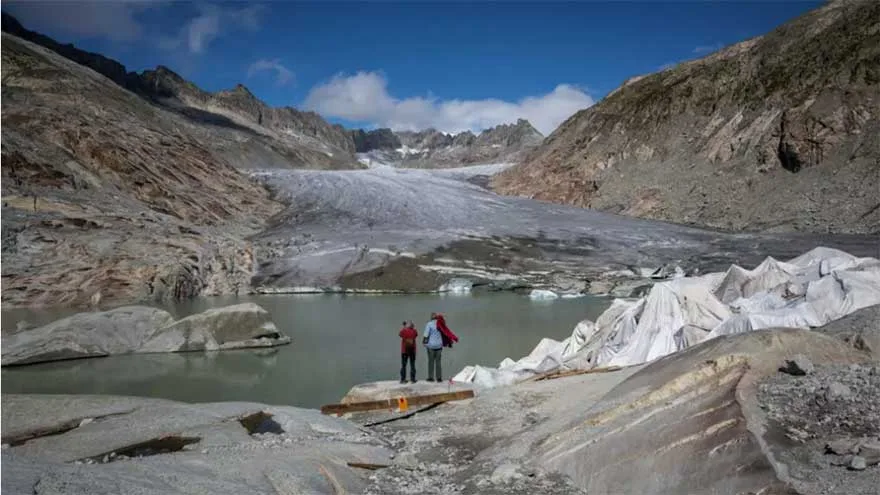
Europe faced historic heatwave, shrinking glaciers, and record sea temperatures in 2025 as the fast-warming continent grapples with more frequent climate extremes. The European State of the Climate report underscores the urgent need for Europe to adapt to global warming and accelerate its transition to clean energy.
Key findings from the EU’s Copernicus Climate Change Service and the World Meteorological Organisation (WMO) include:
Record heatwaves: At least 95 percent of the region experienced above-average annual temperatures, with Britain, Norway, and Iceland recording their warmest year on record. Heatwaves became more frequent and severe in 2025.
Rapid warming rates: Europe has been warming twice as fast as the global average since 1980, making it the fastest-warming continent on Earth. WMO Secretary-General Celeste Saulo highlighted this trend during a briefing.
Extreme heat stress: Sub-Arctic Finland, Norway, and Sweden (Fennoscandia) experienced a record three-week heatwave in July with temperatures reaching 30C within the Arctic Circle. Strong heat stress lasted up to two weeks in parts of Fennoscandia.
Record-breaking temperatures: In Turkey, temperatures reached 50C for the first time in July, while 85 percent of the Greek population was affected by extreme temperatures close to or above 40C.
Significant heatwaves: Large parts of western and southern Europe were hit with two major heatwaves in June, including most of Spain, Portugal, France, and southern Britain. A third major heatwave struck Portugal, Spain, and France in August.
Melting ice: Glaciers across Europe recorded a net mass loss in 2025, with Iceland experiencing its second-largest ever melt. The Greenland Ice Sheet lost around 139 billion tonnes of ice, raising global mean sea level by 0.4 mm.
Europe’s snow cover was the third lowest on record.
Renewables rise: For the third year running, renewable energy produced more electricity than fossil fuels in Europe, accounting for 46.4 percent of power generation. Solar power contributed a record 12.5 percent.
Other extremes: The European annual sea surface temperature was the highest on record for the fourth consecutive year. A record 86 percent of the European ocean region had at least one day with “strong” marine heatwave conditions, impacting biodiversity and seagrass meadows in the Mediterranean.
Storms and floods killed at least 21 people and affected 14,500 across Europe, though flooding and extreme rainfall were less widespread than in recent years.
The Aga Khan University's (AKU) Centre for Innovation in Medical Education (CIME), Karachi, hosted SIMPACT…
Meezan Bank, Pakistan's premier Islamic bank, once again partnered with The Indus Hospital & Health…
Pakistan’s leading digital microfinance bank, Mobilink Bank, and Yango, part of the global technology company…
Pakistan’s freelancing market is rapidly emerging, and the export earnings of Pakistani freelancers are expected…
To celebrate the release of Atif Aslam’s highly anticipated new album, Subah Aye Na, Spotify…
KARACHI: Supernet Technologies Limited (STL) is looking to strengthen its working-capital capacity as a growing…
This website uses cookies.
