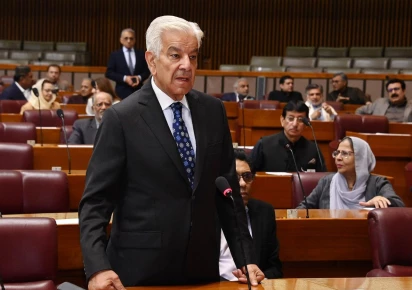
The deadly fire at Karachi’s Gul Plaza dominated proceedings in the National Assembly on Tuesday, triggering heated debate as lawmakers traded blame over governance failures and emergency response shortcomings.
MQM-P leader Farooq Sattar termed the incident a “national tragedy” and accused the Sindh government and city authorities of negligence and delayed action. He said Karachi’s residents were justified in questioning both the provincial and federal governments about the city’s place in national priorities.
The fire, which erupted late Saturday night, has claimed at least 28 lives, while dozens of people remain unaccounted for.
Tensions escalated in the House when MQM-P members tore up agenda papers and demanded the suspension of routine parliamentary business to focus exclusively on the Karachi tragedy. Law Minister Azam Nazeer Tarar subsequently moved a motion to defer the remaining agenda, which was approved by Deputy Speaker Ghulam Mustafa Shah.
Read more: Gul Plaza Faces Scrutiny Over Construction Irregularities
Sattar said decades of neglect had left Karachi critically short of firefighting resources, describing the city as undercounted, underrepresented and underfunded. Paying tribute to firefighter Furqan Ali, who lost his life while battling the blaze, he said accountability was unavoidable and those responsible must answer to the public. He renewed calls for empowered local governments, arguing that a metropolis the size of Karachi could not be effectively governed by a chief minister alone.
Responding to the criticism, PPP leader Shehla Raza said it was not essential for ministers to immediately visit incident sites, stressing that the focus should remain on emergency management. She acknowledged delays in the response due to traffic congestion but maintained that Sindh has an operational local government system.
Later, Defence Minister Khawaja Asif echoed calls for stronger local governments, saying it was “humanly impossible” to manage a city like Karachi under the existing administrative framework.
“I am not blaming individuals, I am blaming the system,” he said, adding that excessive centralisation of authority in provincial capitals had weakened governance. He argued that the spirit of the 18th Amendment had yet to be fully realised, as power had not been effectively devolved to the grassroots level.
Calling the Gul Plaza fire a wake-up call, Asif urged parliament to seriously reconsider constitutional and administrative reforms, saying effective emergency response, accountability and public safety depend on a strong and autonomous local government structure.
Pakistan's diplomatic efforts play key role in easing Middle East tensions Washington has announced a…
On the 24th day of the conflict between the U.S., Israel, and Iran, President Donald…
Authorities in Puerto Rico on Monday seized cocaine worth an estimated $12 million off the…
Alan Ritchson, known for his role in Prime Video's Reacher series, was captured on camera…
ICC Declares Sahibzada Farhan ICC Men's Player of the Month for February The International Cricket…
Sindh Chief Minister Murad Ali Shah Urges National Unity Chief Minister Murad Ali Shah emphasized…
This website uses cookies.
