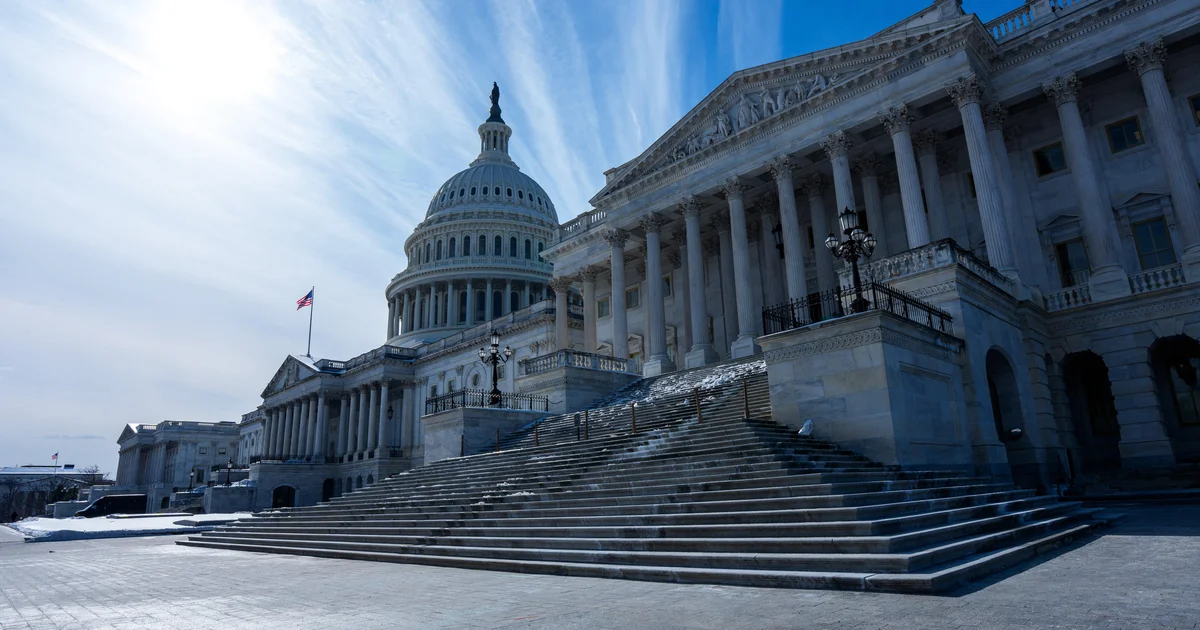
Washington, D.C. – The latest House vote to block President Trump from further military action against Iran narrowly failed Thursday, with the war entering its third month and a resolution for peace remaining uncertain.
The war powers resolution, introduced by Democratic Rep. Gregory Meeks of New York, fell short in a 213 to 214 vote, with one voting present. One Republican crossed party lines, but it was not enough support for passage.
This is the latest test of Congress’ backing for the ongoing conflict that Trump has repeatedly promised would end soon. Since then, peace talks between the U.S. and Iran have collapsed in Pakistan amid a fragile two-week ceasefire, and the U.S. has placed a blockade on vessels using Iranian ports.
Last week’s episode, where Trump threatened to attack Iran’s civilian infrastructure, prompted some Republicans to express unease but had little effect on their voting for the president’s war powers authority. A Democratic-led resolution in the Senate also failed in a Tuesday vote, with just one Republican supportive of it.
House Democrats tried to pass Meeks’ measure last week via unanimous consent during a brief pro forma session but were blocked as the presiding Republican quickly called the session adjourned.
Meeks’ resolution would have directed Trump to remove U.S. armed forces from hostilities against Iran, unless explicitly authorized by Congress.
Three Democrats who voted against the previous war powers resolution in early March – Reps. Henry Cuellar of Texas, Greg Landsman of Ohio and Juan Vargas – backed Thursday’s effort to limit Trump on Iran.
“Landsman said last month announcing his switch that ‘the cost of inaction was far too high to tolerate.’ Cuellar said his change of heart was not a rebuke but a ‘reaffirmation of Congress’ constitutional role.’
Republican Rep. Thomas Massie of Kentucky also voted in favor, while Republican Rep. Warren Davidson of Ohio voted present. Massie and Davidson were the only two House Republicans to break with Trump in the March vote.
Some Republicans have indicated they could shift their votes if the war continues beyond the statutory 60-day deadline, which falls on May 1. The 1973 War Powers Resolution – passed by Congress in response to the Vietnam War as a check on the president’s power to enter armed conflict without consent from the legislative branch – capped any unauthorized engagement at 60 days. But the law has widely been viewed as unconstitutional by presidents from both parties.
The Aga Khan University's (AKU) Centre for Innovation in Medical Education (CIME), Karachi, hosted SIMPACT…
Meezan Bank, Pakistan's premier Islamic bank, once again partnered with The Indus Hospital & Health…
Pakistan’s leading digital microfinance bank, Mobilink Bank, and Yango, part of the global technology company…
Pakistan’s freelancing market is rapidly emerging, and the export earnings of Pakistani freelancers are expected…
To celebrate the release of Atif Aslam’s highly anticipated new album, Subah Aye Na, Spotify…
KARACHI: Supernet Technologies Limited (STL) is looking to strengthen its working-capital capacity as a growing…
This website uses cookies.
