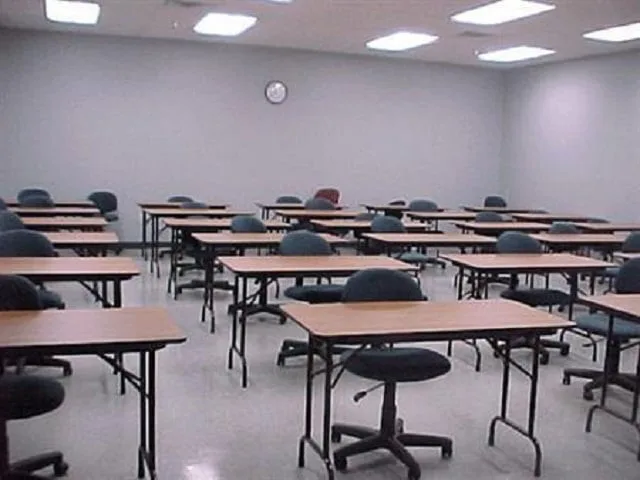
In Punjab, the privatization of education is taking hold as government schools struggle and public institutions falter. Private academies now dominate matric and intermediate exam preparation, fostering a culture driven by marks that has left students entirely reliant on private tutoring centers for their formal education.
The proliferation of tuition centers is alarming to educators and parents alike. With poor teaching quality in government schools, overwhelming curricular demands, and the perception that marks are the sole measure of success, private coaching is now essential—especially for struggling students who cannot afford better education from state institutions. Many parents fear their children will fall behind in a competitive academic race without private tutoring.
Hussain Khalid, a student attending a private academy, explained his predicament: “Professors at government colleges do not provide enough instruction or guidance; I have no choice but to rely on private coaching.” Similarly, Zafir Mushaq, despite being enrolled in a government college, turned exclusively to a coaching center due to its superior quality. Students reported that the dual academic burden—schoolwork and tutoring—is overwhelming. Continuous study from dawn until dusk leaves little time for sports, arts, or leisure.
Psychologist Dr Shahzad Tahir warned of the mental toll: “Excessive academic pressure at a young age can lead to irritability, loss of confidence, and aversion to learning.” The government has implemented limited measures, prohibiting teachers from running tuition during official hours and shutting down unregistered centers. Despite these efforts, the private sector continues to expand, as parents prioritize securing high marks over quality public education.
According to data from the Education Department, Punjab hosts 205 government colleges and nearly 9,000 schools, including 8,081 high schools and around 900 higher secondary schools. In contrast, the province has more than 570 registered private coaching centers and academies, with over 120 in Lahore alone. The Education Department’s own data indicates that nearly 4,000 unregistered centers operate across Punjab, with over 1,000 found in Lahore alone.
Experts argue that the government’s weak enforcement and lack of long-term planning have allowed coaching centers to thrive unchecked. Rana Liaqat Ali Khan, Secretary of the Punjab Teachers’ Union, criticized the government for promoting privatization and blamed declining standards in public schools for pushing students toward private tutoring. Professor Asif Tanveer highlighted the role of economic uncertainty and a societal focus on exam results over learning quality.
Coaching centers often offer “guaranteed marks” packages, some promising scores as high as 90 to 98 percent, along with promotions like sibling discounts or buy-one-get-one deals to attract students. These lucrative incentives fuel their rapid expansion across urban and semi-urban areas. The Education Department seeks enforcement of regulations but acknowledges that the private sector continues to grow at the expense of public education.
The unchecked growth of coaching centers undermines formal education systems, where many students are forced to compromise on extracurricular activities, creativity, and physical health in order to cope with intense tutoring schedules. Experts warn that without government intervention, the informal tutoring model will dominate for years, widening inequalities and shaping a generation reliant solely on crash courses.
The privatization of education is reshaping Punjab’s learning landscape. Unless public schools improve quality, teacher training strengthens, and private centers are rigorously regulated, tuition-driven learning will remain prevalent, perpetuating an educational gap that stifles holistic development and hinders academic progress for generations to come.
The Aga Khan University's (AKU) Centre for Innovation in Medical Education (CIME), Karachi, hosted SIMPACT…
Meezan Bank, Pakistan's premier Islamic bank, once again partnered with The Indus Hospital & Health…
Pakistan’s leading digital microfinance bank, Mobilink Bank, and Yango, part of the global technology company…
Pakistan’s freelancing market is rapidly emerging, and the export earnings of Pakistani freelancers are expected…
To celebrate the release of Atif Aslam’s highly anticipated new album, Subah Aye Na, Spotify…
KARACHI: Supernet Technologies Limited (STL) is looking to strengthen its working-capital capacity as a growing…
This website uses cookies.
