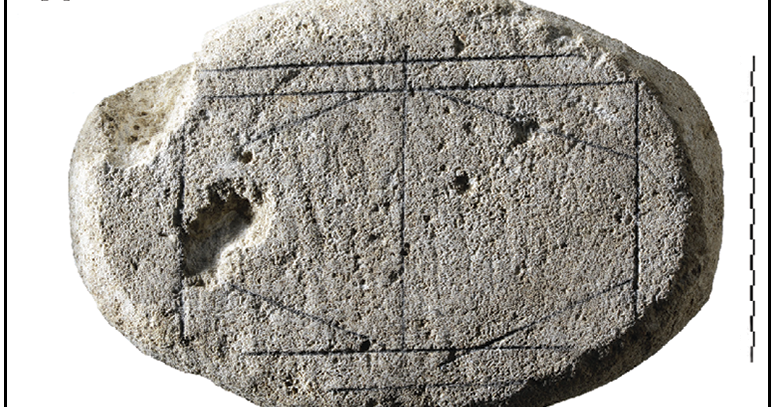
A recently unearthed smooth, white stone dating from the Roman era has long confounded archaeologists. However, recent advancements in artificial intelligence have shed light on this enduring mystery, revealing the stone’s true purpose: an ancient board game that has now been reconstructed with remarkable precision by scientists.
The circular piece of limestone features both diagonal and straight lines etched into its surface. By utilizing 3D imaging from restoration studio Restaura, researchers observed how some lines were more deeply cut than others, suggesting a system for moving pieces along these paths during gameplay.
Walter Crist, an archaeologist at Leiden University specializing in ancient games, confirmed his findings with precision: “We can see wear along the stone’s diagonal and straight line patterns, exactly where you would slide game pieces,” he stated. “This combined appearance is highly suggestive of a board game.”
Further expertise from Maastricht University delved into this puzzle by employing an artificial intelligence program dubbed Ludii. Trained with rules from about 100 ancient games originating from the same region as the Roman stone, Ludii produced dozens of potential rule sets that could have governed such a game.
These findings were then cross-referenced against the wear patterns observed on the artifact to determine which set of movements best fit. Dennis Soemers, from Maastricht University, added: “Ludii found multiple viable game rules, but by playing against itself many times over, it identified variants that humans would find enjoyable.”
While acknowledging Ludii’s versatility and potential limitations, Soemers stressed a significant caveat: “Presenting Ludii with the stone’s line patterns will always yield possible games. However, we cannot be certain this precise interpretation was played in ancient Roman times,” he emphasized.
Scientists have determined the game’s objective to be an engaging strategy challenge—described as “deceptively simple but thrilling”—aimed at trapping opponents’ pieces in fewer moves, typical of blocking games. Researchers surmised that glass, bone, or earthenware would have served as game pieces.
This breakthrough was recently published in the journal Antiquity, accompanied by a video explanation on social media: https://t.co/T4ZsS7zELF @PietteRic @DennisSoemers pic.twitter.com/tqjaUFJS2J
Karen Jeneson, curator of The Roman Museum in Heerlen, added her perspective: “Our research and proposed rules are supported by the wear marks on the stone; they also align with games from comparable cultural periods. While other uses for the stone were considered—such as an architectural feature—we found no alternative explanations. Hence, this artifact truly is a board game.”
In 2015, scientists revealed similar discoveries: ancient Roman game pieces and dice were unearthed in a German settlement near the Rhine River.
As such, this study not only brings us closer to understanding Roman-era entertainment practices but also extends our knowledge of gaming traditions across centuries.
A petition challenging a Rs200 per litre hike in high-octane fuel prices has been filed…
The UK government has decided to release documents related to Andrew Mountbatten-Windsor's time as Trade…
Disney Channel stars Miley Cyrus and Selena Gomez reunited on Monday for the 20th Anniversary…
Everyone is back home after Eid, the suitcases are unpacked, and the excitement of being…
KARACHI - The Muttahida Qaumi Movement (MQM) is urging political parties to implement the 28th…
Emma Slater has addressed rumors about her leaving Dancing with the Stars during an appearance…
This website uses cookies.
