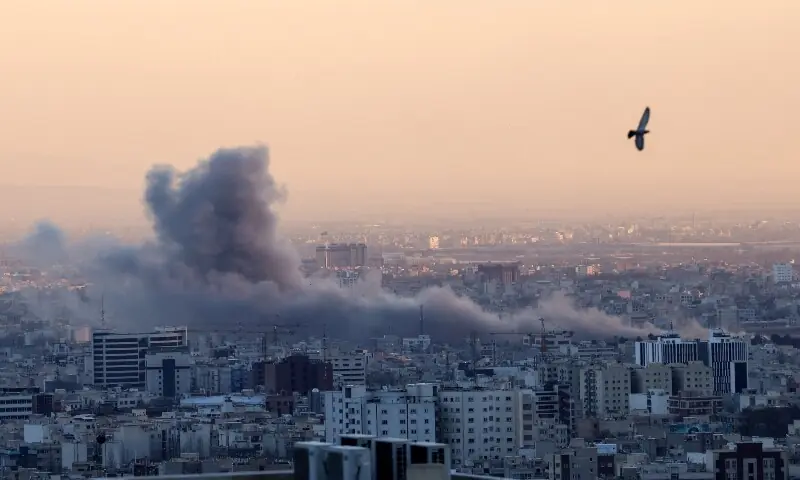
The United States military has recently attacked more than 1,000 targets in Iran, culminating in the assassination of its top officials, including Supreme Leader Ayatollah Ali Khamenei. Critics argue that these actions exceed President Donald Trump’s constitutional authority and violate international law.
President Trump has articulated various objectives for the strikes but did not provide sufficient details or backing from intelligence reports. His statements include claims such as Iran preparing to launch an attack on the US, a possibility he linked to his authorization for military action. Notably, these assertions were not corroborated by official intelligence assessments.
The legitimacy of this military operation remains contentious. Under the U.S. Constitution, only Congress has the authority to declare war, leaving President Trump’s decision under scrutiny. Critics argue that the attacks push the boundaries beyond what is considered a permissible intervention and potentially violate the War Powers Resolution of 1973, which requires presidents to report to Congress on military actions.
Recent legal analyses suggest that without congressional authorization or an explicit declaration of war, these strikes could be considered unlawful. Moreover, Trump’s characterization of the operation as a form of warfare is met with skepticism from many quarters. For instance, the United Nations Charter does not authorize the use of force against other states unless such action is authorized by the UN Security Council or in response to an armed attack.
Critics also argue that the attacks violate principles outlined in the International Law on State Responsibility, which emphasize non-intervention and respect for state sovereignty. The legality further hinges on whether President Trump’s actions constitute a pre-emptive self-defense under international law, particularly considering Iran’s history of potential threats.
While Israel conducted the actual strike against Khamenei, U.S. intelligence provided operational support. However, these operations are not without precedent; in 1981, Republican President Ronald Reagan signed Executive Order 12333 prohibiting assassination by US government entities or its allies.
Given current international law and global reactions to such actions, the U.S. will face significant scrutiny from both diplomatic partners and allies like Israel. Furthermore, legal challenges within Congress could emerge as a key check on Trump’s decision-making process during this ongoing conflict.
The Aga Khan University's (AKU) Centre for Innovation in Medical Education (CIME), Karachi, hosted SIMPACT…
Meezan Bank, Pakistan's premier Islamic bank, once again partnered with The Indus Hospital & Health…
Pakistan’s leading digital microfinance bank, Mobilink Bank, and Yango, part of the global technology company…
Pakistan’s freelancing market is rapidly emerging, and the export earnings of Pakistani freelancers are expected…
To celebrate the release of Atif Aslam’s highly anticipated new album, Subah Aye Na, Spotify…
KARACHI: Supernet Technologies Limited (STL) is looking to strengthen its working-capital capacity as a growing…
This website uses cookies.
