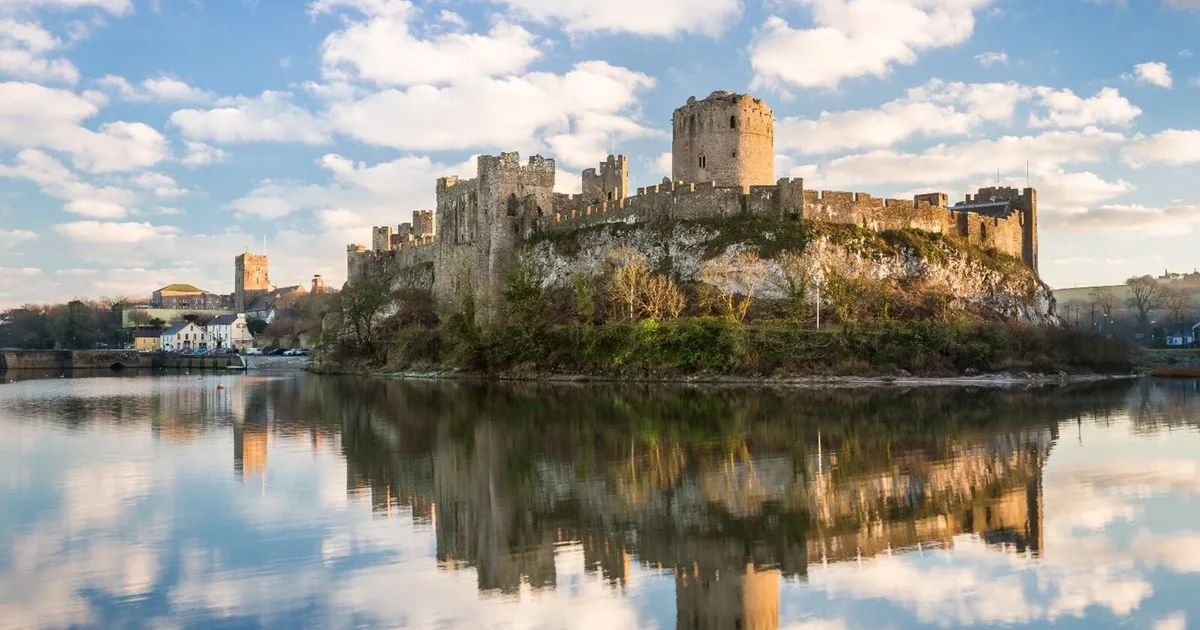
Archaeologists at Pembroke Castle in Wales announced a groundbreaking discovery on Thursday. They found a hidden cave beneath the historic site that could provide significant insights into ancient life in Britain. The cave is believed to be filled with evidence of early humans and animals, including bones from a now-extinct hippopotamus that roamed Wales 120,000 years ago.
The University of Aberdeen will lead a five-year project to excavate the “enormous” cave, accessible via a spiral staircase from the 11th Century castle. Rob Dinnis, who is leading the project, described it as a “once-in-a-lifetime discovery,” noting that there are no other sites like this in Britain.
The cave, previously thought to have been emptied by Victorians, has now been reclassified as one of the most important prehistoric archives in Britain. The team has already found bones from mammoths and reindeer alongside stone tools dating back multiple periods. These findings suggest that humans occupied the cave during various eras, including after the last Ice Age around 11,500 years ago and possibly even earlier Neanderthal presence.
With larger-scale excavation set to begin in May, researchers hope to gain insights into past climate change, extinct species, and human occupation across these periods. The discovery at Pembroke Castle adds a new dimension to its history as a medieval fortress and the birthplace of Henry VII in 1457. Castle manager Jon Williams expressed excitement about continuing work on this remarkable cave.
This find is part of recent scientific revelations about our ancestors. A study earlier this year concluded that fossils discovered in Morocco dating back more than 773,000 years support the theory that Homo sapiens originally appeared in Africa. Neanderthals mostly lived in Europe, while Denisovans roamed Asia. In November, scientists confirmed a mysterious foot found in Ethiopia belonged to an ancient human relative who lived alongside Lucy’s species. In 2022, researchers concluded that Neanderthals and humans coexisted in France and Spain for up to 2,900 years, potentially learning from or even breeding with each other.
BYD, the world’s No. 1 NEV brand, in partnership with Mega Motor Company (MMC), is…
Karachi, Pakistan – September 18, 2026: Mashreq, one of the leading financial institutions in the…
The Aga Khan University's (AKU) Centre for Innovation in Medical Education (CIME), Karachi, hosted SIMPACT…
Meezan Bank, Pakistan's premier Islamic bank, once again partnered with The Indus Hospital & Health…
Pakistan’s leading digital microfinance bank, Mobilink Bank, and Yango, part of the global technology company…
Pakistan’s freelancing market is rapidly emerging, and the export earnings of Pakistani freelancers are expected…
This website uses cookies.
