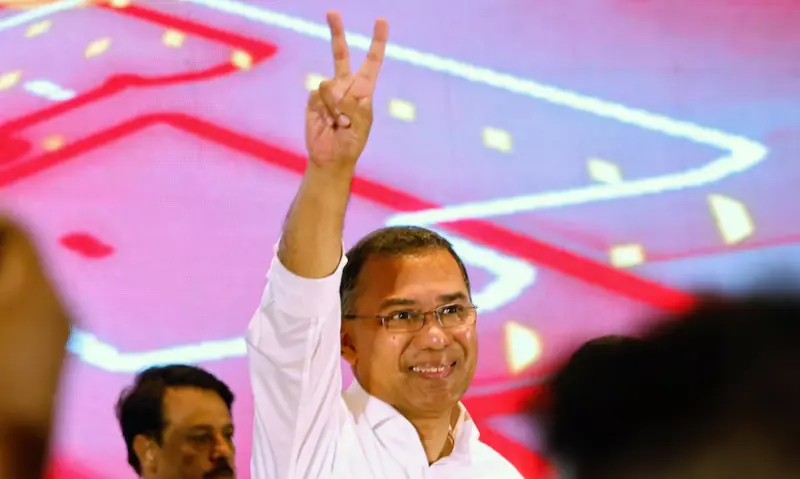
In an election that marked the return to democratic governance in Bangladesh, newly elected lawmakers took their oaths on Tuesday. Among them was Tarique Rahman, who secured victory as the new Prime Minister, succeeding the interim government which had governed for nearly a year since the overthrow of Sheikh Hasina’s autocratic regime.
Rahman, 60 years old and leader of the Bangladesh Nationalist Party (BNP), has promised to lead his nation into recovery from economic crises. His landslide victory in February elections was celebrated not only by BNP members but also by supporters across the country who had long awaited democratic governance.
The Chief Election Commissioner AMM Nasir Uddin administered the oaths of loyalty, after which Rahman will be formally sworn as Prime Minister with a subsequent oath by President Mohammed Shahabuddin. The BNP coalition won 212 seats in parliament, a significant increase from Hasina’s Awami League, whose alliance claimed only 77.
The new leader’s path to stability is laden with challenges—economic downturns and the need for constitutional reforms are paramount issues. Rahman has been clear about his vision: “We are about to begin our journey in a situation marked by a fragile economy left behind by the authoritarian regime, weakened constitutional and statutory institutions, and a deteriorating law and order situation.”
The BNP coalition’s victory is expected to be met with skepticism from Jamaat-i-Islami. Despite challenges, Jamaat leader Shafiqur Rahman has acknowledged his party’s role as an “vigilant, principled, and peaceful opposition.” India’s approval of the BNP’s decisive win marks a significant shift in international relations.
Despite hurdles, Bangladesh responded to its election results with relative calmness. The election saw seven women directly elected, while parties reserved seats for 50 additional female members based on their electoral performance. Four representatives from minority communities won seats as well.
Only days before the polls, there had been concerns over potential unrest due to past political turmoil between rival parties. However, these worries did not materialize, and voter turnout was deemed satisfactory across the nation.
While Rahman’s task will be daunting—including tackling economic issues—many believe his commitment could lead to a more stable future for Bangladesh. “If the BNP can do a good job with the economy,” said Crisis Group analyst Thomas Kean, “it will make everything else easier for the government.”
The Aga Khan University's (AKU) Centre for Innovation in Medical Education (CIME), Karachi, hosted SIMPACT…
Meezan Bank, Pakistan's premier Islamic bank, once again partnered with The Indus Hospital & Health…
Pakistan’s leading digital microfinance bank, Mobilink Bank, and Yango, part of the global technology company…
Pakistan’s freelancing market is rapidly emerging, and the export earnings of Pakistani freelancers are expected…
To celebrate the release of Atif Aslam’s highly anticipated new album, Subah Aye Na, Spotify…
KARACHI: Supernet Technologies Limited (STL) is looking to strengthen its working-capital capacity as a growing…
This website uses cookies.
