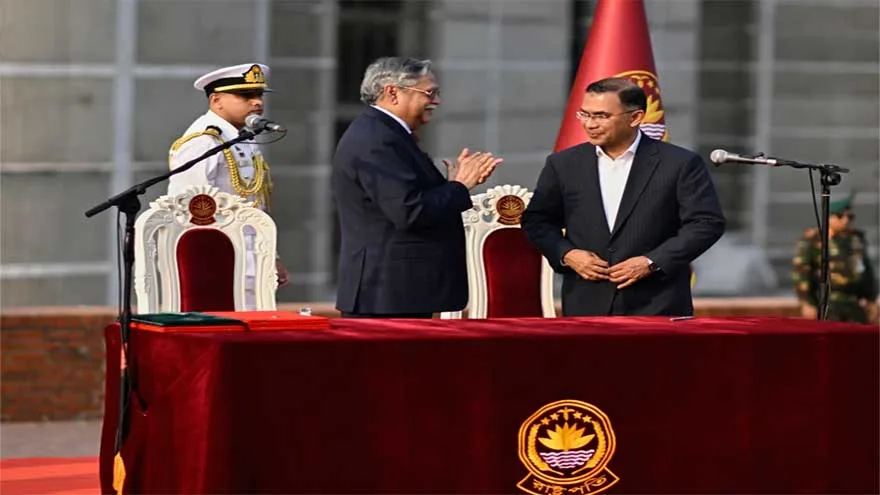
In Bangladesh’s most pivotal election in recent memory, Prime Minister Tarique Rahman, son of the nation’s former leader Khaleda Zia and heir to his father’s mantle, was sworn into office on Tuesday. His party, the Bangladesh Nationalist Party (BNP), secured an overwhelming majority, capturing 212 out of 350 parliamentary seats, far surpassing expectations despite years of rivalry with the Jamaat-e-Islami coalition.
DHAKA, Bangladesh — The election marked a significant reset for Bangladesh’s political landscape following the massive uprising in 2024 and has been touted as pivotal to determining the country’s future. Rahman, now aged 60 and returning after a decade-long exile from London, promised swift action towards restoring democracy and stability.
The interim government led by Nobel Peace Prize laureate Muhammad Yunus, which took charge post-Hasina’s ouster last year, oversaw these elections with relative calmness amid international observers’ approval. High-level foreign dignitaries including Maldives President Mohamed, Bhutan Prime Minister Tshering Tobgay, and Indian delegations were among the guests present at the swearing-in ceremony.
The Bangladesh Nationalist Party’s victory was bolstered by their alliance with other parties totaling 212 seats in Parliament, while the Jamaat-e-Islami bloc led a diverse group of 11 parties securing only 77 out of 350 seats. This opposition included six members from the newly formed National Citizen Party (NCP) led by student activists who spearheaded the 2024 uprising.
The election saw voters electing directly 300 members of Parliament, with the remaining reserved for women distributed proportionately among the winning parties. Rahman’s administration, which began with an interim government under Nobel laureate Muhammad Yunus, took over smoothly from the ousted Hasina-led Awami League.
Despite the Bangladeshi Election Commission administering initial oaths to all newly elected lawmakers, Rahman’s BNP party refused to take a second oath as part of proposed constitutional reform. This move was made in compliance with a referendum held concurrently with Thursday’s voting. The referendum aimed at implementing stricter checks on executive power and limiting parliamentary consolidation, though critics contend these reforms risk altering the country’s secular foundations.
Hasina, once a dominant political force, is now under house arrest following her party’s ban by the interim government for activities deemed illegal since her ouster. As she remains in exile in India, Hasina has criticized the election as unfair and argued against the verdict on her death penalty case, dismissing it as part of “a kangaroo court.”
Former Department of Homeland Security Secretary Kristi Noem is facing allegations that her husband, Bryon…
JPMorgan Chase CEO Jamie Dimon discussed potential expansion into prediction market services during an interview…
King Charles and Queen Camilla set to attend Royal Maundy Service at St Asaph Cathedral…
Prince William honoured Warwick Davis with an Officer of the Order of the British Empire…
American journalist Shelly Kittleson was kidnapped in Baghdad on Tuesday, according to two sources familiar…
US conservative activist Charlie Kirk, a key ally of President Donald Trump, was fatally shot…
This website uses cookies.
