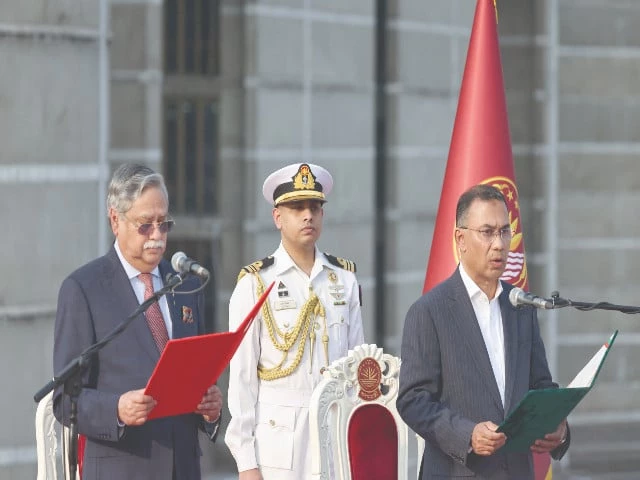
Bangladesh witnessed a new dawn on Tuesday as Prime Minister Tarique Rahman took his oath of office, marking a fresh start for the first elected government since a tumultuous uprising in 2024. Despite facing formidable challenges ahead—including securing stability amidst deep political divides and bolstering the nation’s faltering economy—the seasoned 60-year-old is poised to lead a nation on the cusp of significant transformation.
Rahman, head of the Bangladesh Nationalist Party (BNP) and heir to one of the country’s most influential political families, assumed office following an interim administration that has steered the diverse populace for nearly two years. His victory was celebrated across the spectrum, from his election triumph on February 12th, where he secured a landslide majority over rival Sheikh Hasina’s Awami League, through to his inauguration ceremony held outside parliament.
“I will dutifully discharge my duties as prime minister in accordance with the law,” Rahman pledged during his solemn swearing-in by President Mohammed Shahabuddin. “This victory is not just for Bangladesh but also for democracy itself,” he declared, highlighting the broader impact of this democratic achievement on society and governance.
Rahman’s administration faces pressing priorities: repairing security vulnerabilities, mending societal rifts exacerbated over years of political strife, and addressing the economic predicaments that have plagued Bangladesh’s second-largest garment industry. The new government has vowed to rebuild stability following months of unrest that had rattled investor confidence in one of Asia’s most vital economies.
Rahman is also advocating for unity among various factions within a nation long marked by bitter rivalries. His inaugural address emphasized the fragility of the current economic landscape inherited from an authoritarian regime and called for robust governance institutions and law enforcement to stabilize the country moving forward.
As Rahman’s ministers took their oaths, the BNP-led coalition seized power with decisive victories in the February polls—securing 212 seats against only 77 for Jamaat-e-Islami. Despite a few contested constituencies, both parties expressed resilience, pledging continued cooperation and principled opposition as they unite to steer Bangladesh towards stability.
The inauguration marked a significant milestone for Rahman, who only returned from exile in Britain after seventeen years, a testament to the democratic path that led him back home. His political journey from abroad has now culminated with his swearing-in ceremony, a symbol of hope for the nation.
Notably, while women accounted for just seven directly elected positions at the time of the election, Rahman promised an inclusive approach by allocating reserved seats based on party performance to ensure broader representation across the populace. Bangladesh’s diverse communities saw four members among the new faces in parliament—two Hindus, who constitute approximately 7% of the population.
Following the polls, while some factions expressed skepticism and contesting results, India recognized the BNP’s decisive win—a surprising departure from previous strained relations between these two neighboring countries. Prime Minister Shehbaz Sharif of Pakistan extended his warmest felicitations to Rahman on Twitter, emphasizing their commitment to strengthening bilateral cooperation across mutually beneficial domains.
The inauguration ceremony also witnessed high-level support from President Asif Ali Zardari, who highlighted the interim government’s efforts in organizing a peaceful and fair election. He wished for both countries’ stability and prosperity, underscoring the importance of regional peace among allies and partners.
As Rahman begins his tenure, the immediate focus will be on stabilizing the economy—a critical step towards healing the nation’s wounds from years of political strife. Critics argue that addressing economic challenges may prove more challenging than consolidating power, yet many hope that with Rahman’s leadership, Bangladesh can finally achieve long-awaited stability and prosperity.
In this new chapter, both international observers and internal stakeholders watch closely as Tarique Rahman takes up his mantle to guide a nation on the brink of transformation.
Pope Leo XIV Warns God Rejects Prayers of War The Pope's Palm Sunday Homily Stresses…
HBO CEO Casey Bloys has confirmed that work on the second season of the upcoming…
Artist Aroosa Rana's 'The Golden Ratio - Math of Beauty' opens at Canvas Art Gallery…
Federal ministers, state ministers, advisors, and special assistants have received a combined salary and allowance…
Iranian Island of Kharg Central to US-Iran Tensions A scrubby island in the Gulf that…
Eight Muslim nations, including Pakistan, Egypt, Jordan, the United Arab Emirates, Indonesia, Turkey, Saudi Arabia,…
This website uses cookies.
