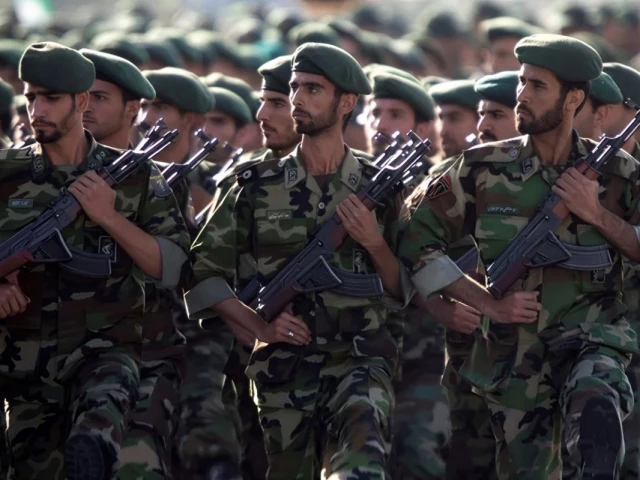
European Union foreign ministers agreed Thursday to list the Islamic Revolutionary Guard Corps (IRGC) as a terrorist organization, putting the powerful Iranian group on par with groups such as ISIS and al-Qaeda. The decision comes days after the bloc witnessed what it termed a brutal crackdown during a nationwide protest movement, which resulted in thousands of deaths.
EU Foreign Policy Chief Kaja Kallas emphasized that “repression cannot go unanswered,” tweeting her stance on the matter. She argued that any regime capable of executing such large-scale killings is inherently on its way to destruction.
The IRGC was established following Iran’s 1979 Islamic Revolution to safeguard the clerical government, exerting significant influence over both the economy and military apparatus. The group oversees Iran’s ballistic missile and nuclear programs.
While some EU member states had previously pushed for the IRGC’s inclusion on the bloc’s terrorist list, others remained cautious out of concerns that it could disrupt communications with Iran’s government and potentially endanger Europeans within its borders.
However, the recent severe crackdown during a nationwide protest movement intensified support for designating the IRGC as a terrorist organization. Dutch Foreign Minister David van Weel noted that “the bloodshed and brutality used against protesters cannot be tolerated.”
France and Italy, initially reluctant to label the IRGC, joined in this decision this week. Despite fears of damaging relations with Iran over these sanctions, Kallas reassured reporters that diplomatic channels are expected to remain open even after listing the Revolutionary Guards.
The Council of the European Union adopted accompanying sanctions targeting 15 individuals responsible for significant human rights violations and six entities “involved in censoring activities on social media.” Sanctions also extended to four individuals and six entities related to Iran’s drone and missile programs, including components used in their development and production.
Furthermore, the EU sanctioned an Iranian Interior Minister, a Prosecutor General, several IRGC commanders, and senior law enforcement officials. Entities included the Audio-Visual Media Regulatory Authority and software companies accused of censoring social media activities and spreading misinformation online.
In summary, the EU’s decision to classify the IRGC as a terrorist organization marks a significant shift in its policies toward Iran, responding to human rights abuses while maintaining some diplomatic channels with the country.
The Aga Khan University's (AKU) Centre for Innovation in Medical Education (CIME), Karachi, hosted SIMPACT…
Meezan Bank, Pakistan's premier Islamic bank, once again partnered with The Indus Hospital & Health…
Pakistan’s leading digital microfinance bank, Mobilink Bank, and Yango, part of the global technology company…
Pakistan’s freelancing market is rapidly emerging, and the export earnings of Pakistani freelancers are expected…
To celebrate the release of Atif Aslam’s highly anticipated new album, Subah Aye Na, Spotify…
KARACHI: Supernet Technologies Limited (STL) is looking to strengthen its working-capital capacity as a growing…
This website uses cookies.
