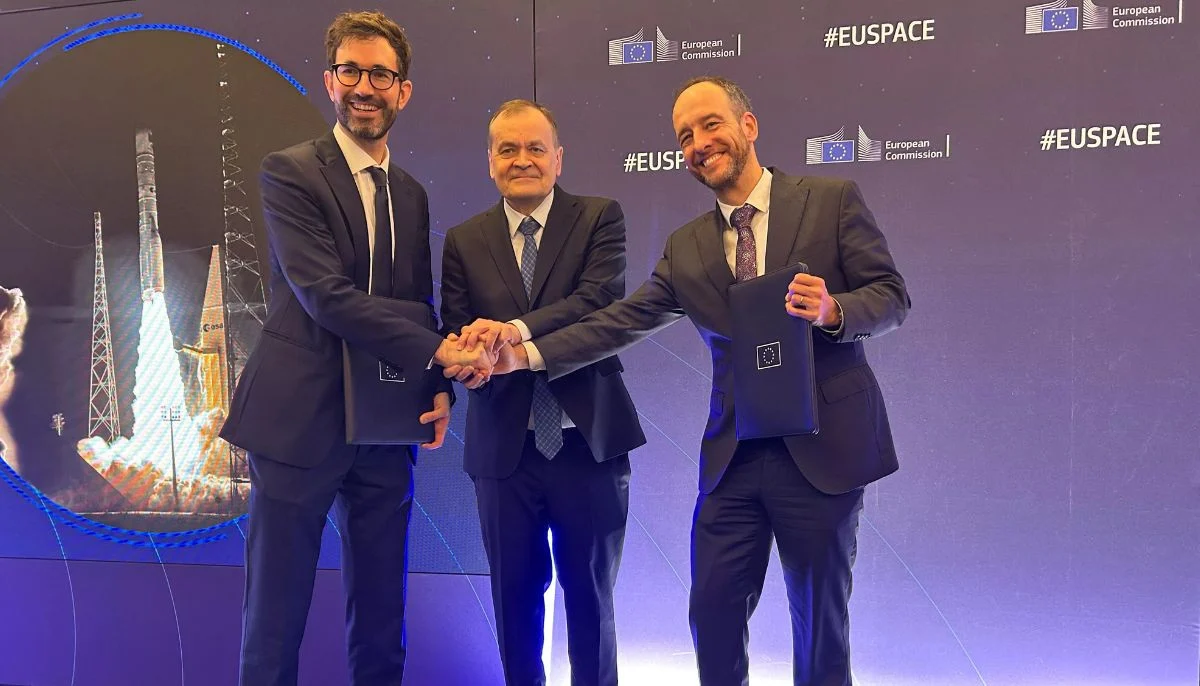
The European Union Agency for the Space Programme (EUSPA) and Arianespace have signed a new contract for the launch of the second pair of Galileo Second Generation (G2) satellites using Europe’s Ariane 6 rocket launcher. The Galileo L18 mission marks the fifth Ariane 6 launch in support of the Galileo programme.
Ariane 6 successfully completed its inaugural Galileo mission on December 17, 2025, placing two Galileo satellites into orbit.
In addition, the Galileo Control Centres in Fucino and Oberpfaffnhofen now manage these satellites directly. Two further Ariane 6 launches are planned to complete the first generation of Galileo satellites before the Galileo L17 mission deploys the first pair of second-generation satellites.
Previously, the EU relied on Elon Musk’s SpaceX for launching its strategic satellites. However, returning to the Ariane 6 launcher is a significant step towards ensuring autonomous location services independent of the US Global Positioning System (GPS).
The development of Galileo Second Generation (G2) satellites promises enhanced performance, resilience, and future-proof capabilities. This ensures that the EU satellite navigation system remains a world-class asset serving both public authorities and users worldwide.
The Aga Khan University's (AKU) Centre for Innovation in Medical Education (CIME), Karachi, hosted SIMPACT…
Meezan Bank, Pakistan's premier Islamic bank, once again partnered with The Indus Hospital & Health…
Pakistan’s leading digital microfinance bank, Mobilink Bank, and Yango, part of the global technology company…
Pakistan’s freelancing market is rapidly emerging, and the export earnings of Pakistani freelancers are expected…
To celebrate the release of Atif Aslam’s highly anticipated new album, Subah Aye Na, Spotify…
KARACHI: Supernet Technologies Limited (STL) is looking to strengthen its working-capital capacity as a growing…
This website uses cookies.
