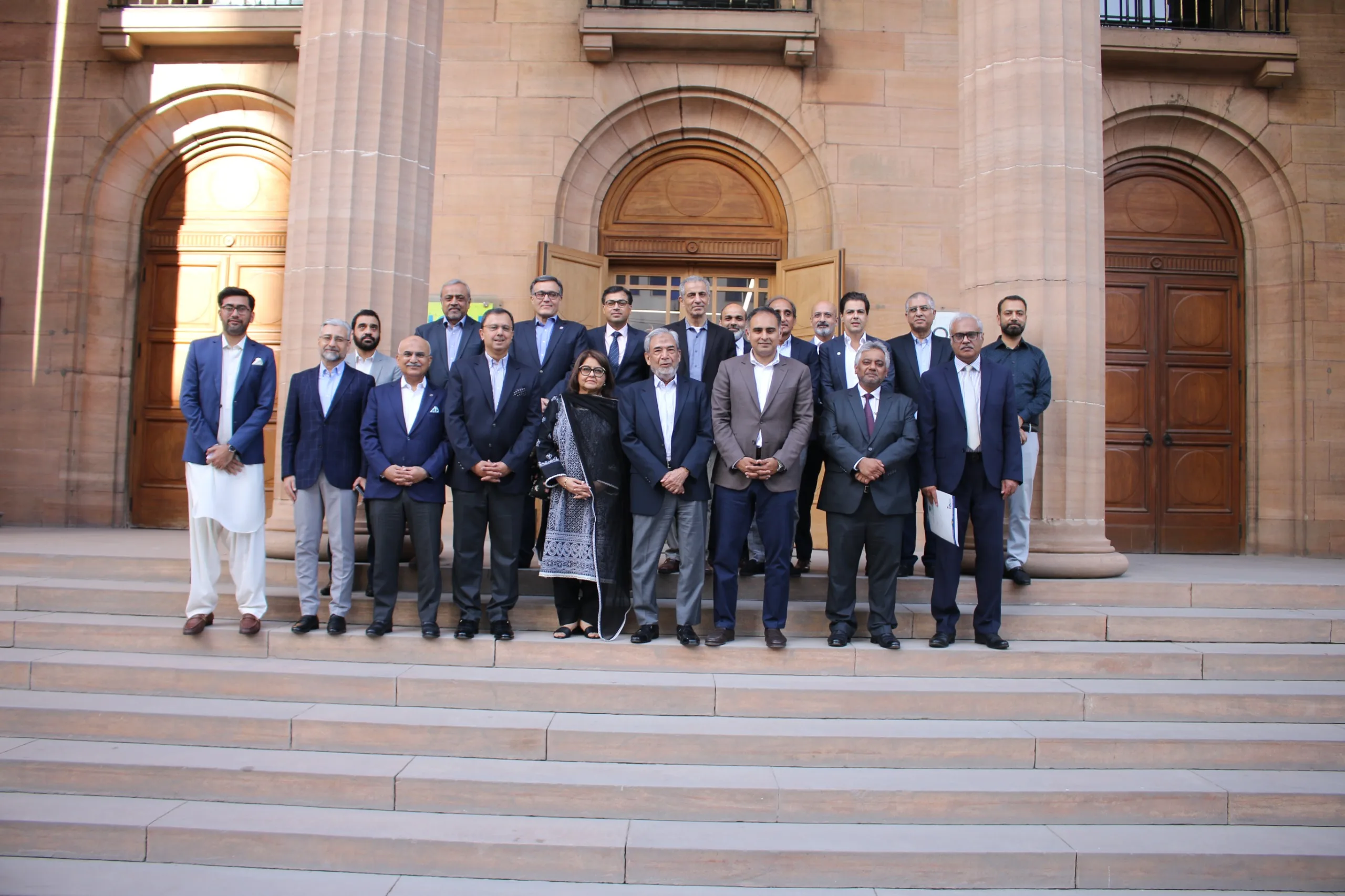
During the visit of Minister of State for Finance and Revenue Bilal Azhar Kayani to the Chamber, the Overseas Investors Chamber of Commerce and Industry (OICCI) elaborated its key tax recommendations for the Federal Budget 2026–27, developed through extensive member consultations. Dr. Najeeb Memon, Director General, Tax Policy Office (TPO), also participated virtually.
The engagement formed part of the Ministry of Finance’s ongoing budget formulation process and the Federal Minister for Finance and Revenue’s consultations with industry stakeholders.
The Minister of State welcomed input from foreign investors and highlighted the importance of sustained stakeholder engagement to support growth, broaden the tax base and enhance transparency.
The Chamber proposed reducing the corporate tax rate to 28 percent in FY2026–27, with a phased reduction to 25 percent over three years, and the gradual abolition of the Super Tax. It noted that the combined impact of Corporate Tax, Super Tax, Workers Welfare Fund and Workers Profit Participation Fund raises the effective tax rate to nearly 46 percent. OICCI also highlighted that disproportionately high taxation on the banking sector can act as a constraint on economic growth by affecting banks’ ability to efficiently deploy capital, which in turn impacts the availability and cost of working capital for businesses across the economy.
To retain talent, OICCI recommended abolishing the super tax and the 10 percent surcharge on higher-income salaried brackets, and capping the maximum personal tax rate at 25 percent.
Further proposals included rationalising withholding taxes, reducing sales tax on goods from 18 percent to 17 percent with a path towards 15 percent, and reviewing minimum and alternate minimum tax provisions.
OICCI Secretary General M. Abdul Aleem said the proposals aim to deliver a fair, predictable and investment-friendly tax system, anchored in documentation and digitisation. Emphasising the need to expand the tax net rather than increase the burden on existing taxpayers, he noted that all segments of the economy, including agriculture, retail and wholesale, real estate and services, should contribute proportionately to their economic share.
During the meeting, foreign investors raised operational concerns, including delays in tax refunds, excessive compliance notices despite strong records, and weak coordination between federal and provincial systems.
OICCI also highlighted the importance of supporting export-led industrial sectors as a core pillar of medium-term growth, noting that targeted policy support and, where required, appropriate flexibility within IMF programme frameworks should be considered to sustain competitiveness.
OICCI expressed hope that these measures would create a predictable and balanced tax regime, strengthen compliance, encourage investment and support Pakistan’s transition to sustainable, export-led growth.
The Aga Khan University's (AKU) Centre for Innovation in Medical Education (CIME), Karachi, hosted SIMPACT…
Meezan Bank, Pakistan's premier Islamic bank, once again partnered with The Indus Hospital & Health…
Pakistan’s leading digital microfinance bank, Mobilink Bank, and Yango, part of the global technology company…
Pakistan’s freelancing market is rapidly emerging, and the export earnings of Pakistani freelancers are expected…
To celebrate the release of Atif Aslam’s highly anticipated new album, Subah Aye Na, Spotify…
KARACHI: Supernet Technologies Limited (STL) is looking to strengthen its working-capital capacity as a growing…
This website uses cookies.
