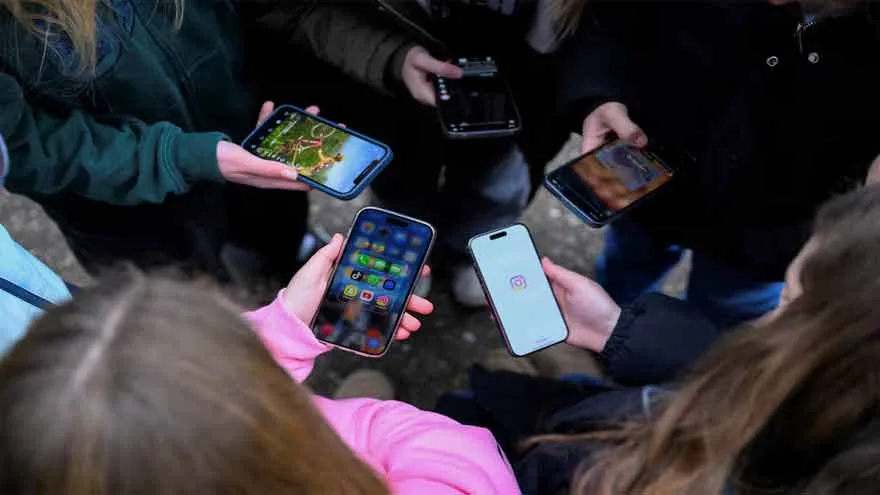
Germany’s ruling conservatives have backed new measures to ban social media use for children under 14 and strengthened digital verification checks for teenagers. This move comes as a growing number of countries like Spain, Greece, France, and Britain consider similar restrictions on platforms such as TikTok or Instagram.
At a party conference in Stuttgart, Chancellor Friedrich Merz’s Christian Democratic Union (CDU) called for fines against social media platforms that do not enforce these limits and advocated for European-wide harmonization of age standards. The motion passed with support from both the CDU and its coalition partner, the Social Democrats.
Germany’s federal system complicates enforcement; states must negotiate across lines to establish consistent nationwide rules. Merz’s party has also proposed a legal age limit of 14 for social networks’ use and protection measures up to the age of 16.
The ban could affect children in schools like the Cardinal Frings Gymnasium in Bonn, where some students have been observed scrolling on their phones during school breaks. The proposal faces differing views: Children argue it’s a fair step by the state; parents assert parental decision-making should prevail. However, many adolescents acknowledge social media’s addictive nature and suggest alternatives for communication once the restrictions are put into place.
Moritz, 13, from Bonn believes age 12 is an appropriate cut-off point for restricting social media use. His classmate Emma, who uses Snapchat with time limits, supports a ban but thinks children can distinguish between fake news and authentic content at older ages. Ella, 12, scrolls multiple times daily, understanding the addictive nature of digital platforms.
Teachers in schools are preparing for an initial shock among students to new regulations; they predict that over time, children would find other ways to communicate with peers. This shift underscores broader discussions about child internet safety and social media regulation across Europe as countries increasingly push back on U.S.-based tech giants.
The Aga Khan University's (AKU) Centre for Innovation in Medical Education (CIME), Karachi, hosted SIMPACT…
Meezan Bank, Pakistan's premier Islamic bank, once again partnered with The Indus Hospital & Health…
Pakistan’s leading digital microfinance bank, Mobilink Bank, and Yango, part of the global technology company…
Pakistan’s freelancing market is rapidly emerging, and the export earnings of Pakistani freelancers are expected…
To celebrate the release of Atif Aslam’s highly anticipated new album, Subah Aye Na, Spotify…
KARACHI: Supernet Technologies Limited (STL) is looking to strengthen its working-capital capacity as a growing…
This website uses cookies.
