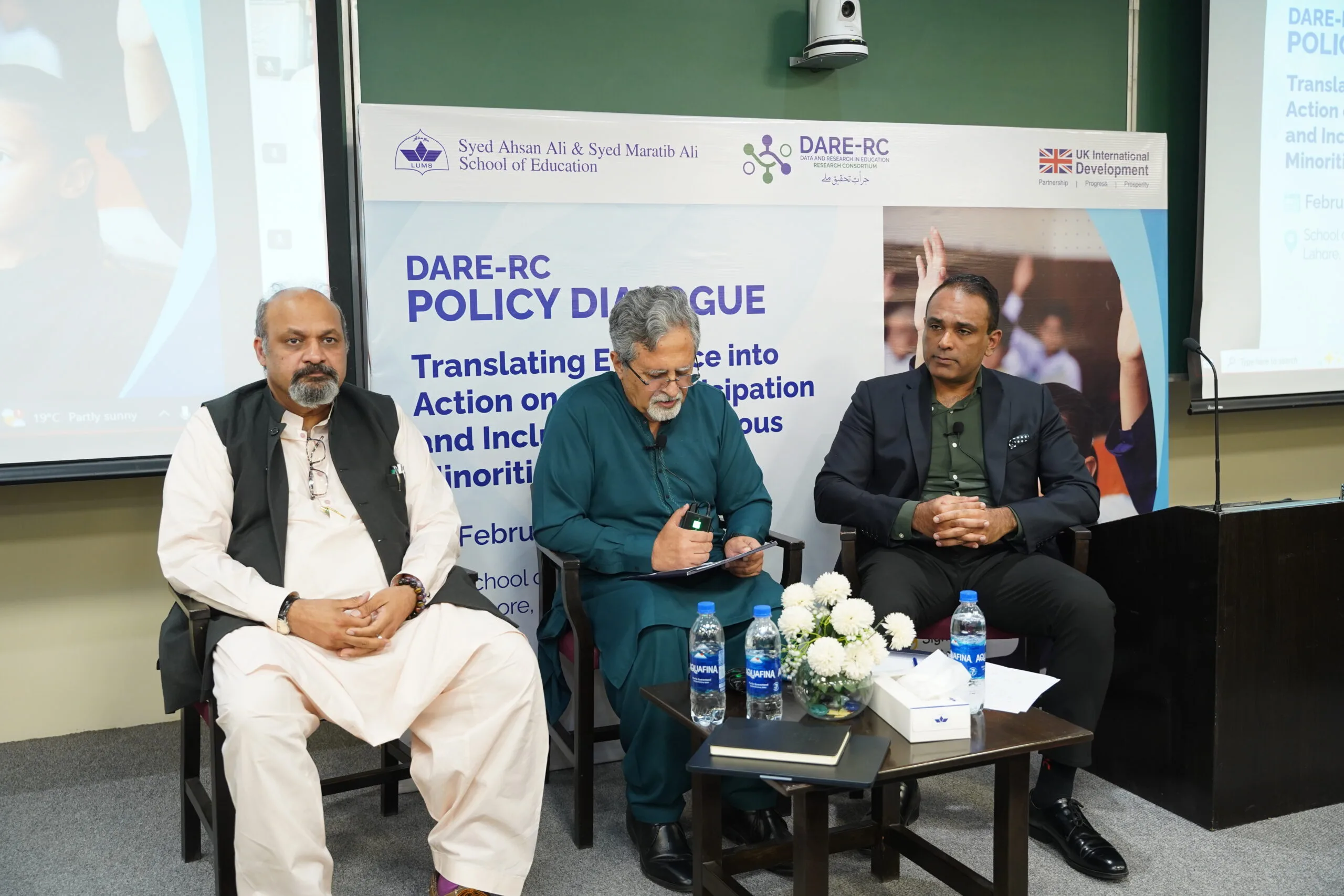
A high-level policy dialogue at LUMS called for stronger evidence-based reforms to improve girls’ retention in middle school and enhance inclusion for children from religious minority backgrounds.
The third Policy Dialogue, convened by the Data and Research in Education – Research Consortium (DARE-RC) in collaboration with the Syed Ahsan Ali and Syed Maratib Ali School of Education at LUMS, brought together senior policymakers, researchers, and development partners to translate research findings into practical policy measures.
Speaking at the event, Mudassar Riaz Malik, Secretary, School Education Department, Punjab, underscored the operational importance of research-policy collaboration. He stated, “This policy dialogue is extremely important for us. We need to ground our decisions in evidence and move firmly toward evidence-based policymaking, not policy-based evidence-making. The issue is not always policy often it is structural. Our responsibility is to convert research recommendations into concrete, implementable action plans that strengthen the education system.”
He stressed that sustained engagement between academia and government is essential to address dropout trends, improve accountability, and ensure inclusive reforms across the education system.
Earlier, Ben Warrington, Head of the British High Commission Office in Lahore (FCDO), highlighted the need to connect research with reform. He noted, “Strengthening an education system takes an entire ecosystem. It is crucial to connect rigorous research to policy action and practical decision-making.”
The session featured presentations by Dr. Zainab Latif, Senior Fellow at Tabadlab, who shared findings on barriers contributing to girls’ middle-school dropout, and Dr. Ibtasam Thakur, HOD Special Education at Lahore College for Women University, who presented research on the educational experiences of children from religious minority backgrounds.
The interactive panel discussion also included LUMS faculty members, Drs. Faisal Bari and Tayyaba Tamim, alongside policymakers and development experts, focusing on retention strategies, teacher training reforms, and strengthening inclusive education frameworks.
The dialogue reinforced the importance of coordinated reforms and sustained collaboration to advance equitable and quality education in Pakistan.
The Aga Khan University's (AKU) Centre for Innovation in Medical Education (CIME), Karachi, hosted SIMPACT…
Meezan Bank, Pakistan's premier Islamic bank, once again partnered with The Indus Hospital & Health…
Pakistan’s leading digital microfinance bank, Mobilink Bank, and Yango, part of the global technology company…
Pakistan’s freelancing market is rapidly emerging, and the export earnings of Pakistani freelancers are expected…
To celebrate the release of Atif Aslam’s highly anticipated new album, Subah Aye Na, Spotify…
KARACHI: Supernet Technologies Limited (STL) is looking to strengthen its working-capital capacity as a growing…
This website uses cookies.
