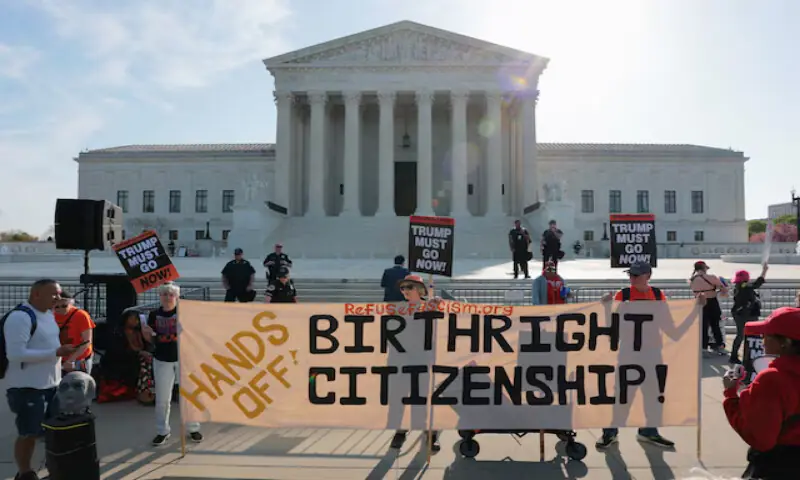
A Reuters/Ipsos poll reveals that 64% of Americans oppose ending birthright citizenship for babies born in the US, as the high court prepares to rule on President Donald Trump’s efforts to end this practice.
The Supreme Court is set to issue rulings on a range of polarizing issues in coming weeks, including immigration policy and transgender rights. These decisions could shape Republican president’s legacy and key rules for November 3 midterm elections.
Trump’s executive order was challenged in court, with the high court expected to rule by end June in what will be a landmark civil rights case and test for Trump’s hardline immigration agenda.
Public perception of birthright citizenship is split along party lines. Only 9% of Democrats think it should be scrapped, but Republicans are divided, with 62% supporting an end to the policy and 36% favoring its retention.
The Supreme Court often issues high-profile rulings in May and June as it nears the end of its annual term. In Idaho and West Virginia cases, the court is expected to allow states to pass laws restricting transgender athletes’ participation in women’s sports.
A Reuters/Ipsos poll found broad support for restrictions on transgender girls and women competing in women’s school and college sports, with 67% of respondents supporting bans. Ninety-two percent of Republicans supported such bans compared with just 44% of Democrats.
The court will also weigh in on whether states can count mail-in ballots that are postmarked by Election Day but received days later. About 65% of respondents support counting these ballots, even if they arrive late.
Eighty-five percent of Democrats back this approach to counting mail-in ballots compared with just 51% of Republicans.
Another case will determine the constitutionality of a Louisiana congressional map drawn to raise the number of Black-majority districts from one to two. A group of white voters want the Supreme Court to block the map, arguing it was guided too much by racial considerations.
Public views on these matters are nuanced. Some 75% of poll respondents, including 65% of Black respondents, said race should not be considered when drawing congressional maps. But about half of respondents and six in ten Black respondents believed communities sharing characteristics, including race, should be represented in the same district.
The Supreme Court has issued major rulings expanding gun rights, rejecting race-conscious college admissions, and curbing federal agencies’ power in recent years. Its conservative majority includes three justices appointed by Trump during his first term.
American views on the Supreme Court have become more partisan over the past five years. In a March Reuters/Ipsos survey, 70% of Republicans viewed it favorably compared with just 27% of Democrats. In December 2021, before the court overturned Roe v Wade in 2022, 66% of Republicans liked the court compared with 55% of Democrats.
The Aga Khan University's (AKU) Centre for Innovation in Medical Education (CIME), Karachi, hosted SIMPACT…
Meezan Bank, Pakistan's premier Islamic bank, once again partnered with The Indus Hospital & Health…
Pakistan’s leading digital microfinance bank, Mobilink Bank, and Yango, part of the global technology company…
Pakistan’s freelancing market is rapidly emerging, and the export earnings of Pakistani freelancers are expected…
To celebrate the release of Atif Aslam’s highly anticipated new album, Subah Aye Na, Spotify…
KARACHI: Supernet Technologies Limited (STL) is looking to strengthen its working-capital capacity as a growing…
This website uses cookies.
