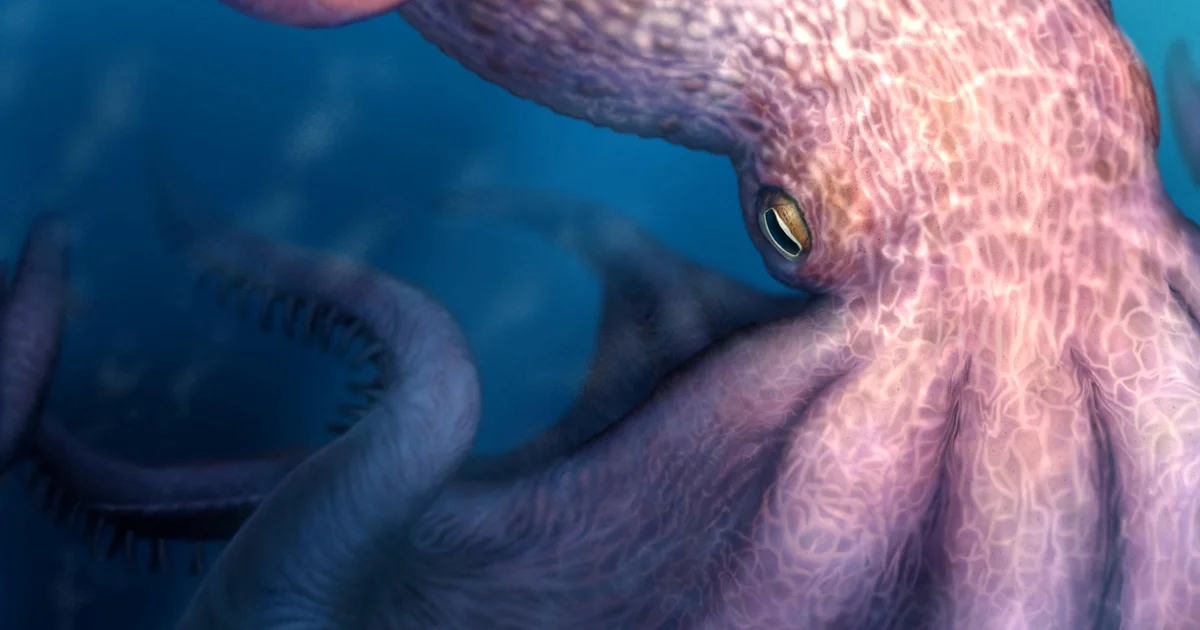
New analyses of fossilized jaws suggest that massive, kraken-like octopuses once roamed the seas during the age of dinosaurs 100 million years ago.
These ancient creatures boasted eight arms and long bodies extending over 60 feet, rivaling other carnivorous marine reptiles. University of Alabama paleontologist Adiel Klompmaker stated, “These krakens must have been a fearsome sight to behold.”
During the late Cretaceous era, sharp-toothed sharks and sea reptiles like mosasaurs and plesiosaurs dominated dinosaur-era waters. Despite previous studies on giant octopus relatives and small drilling octopuses, their soft bodies rarely fossilize.
The new study analyzed 15 ancient octopus fossils from Japan and Canada’s Vancouver Island, identifying 12 more jaws using digital fossil mining techniques. Researchers compared these to modern octopuses, estimating the ancient creatures ranged from 23 to 62 feet in length. The largest jaw was substantially bigger than any modern octopus.
Co-author Yasuhiro Iba with Hokkaido University noted, “The predator is one of the largest invertebrates on record.” The researchers found significant wear and tear on the largest jaws, indicating they crushed hard prey like shells and bones repeatedly.
Without stomach content analysis, it’s unclear what these ancient octopuses ate or if they competed with other top predators. They could have consumed fish or snails, using their flexible arms to snatch and break apart prey.
The researchers concluded that powerful jaws and the loss of superficial skeletons transformed cephalopods into huge, intelligent predators. Paleontologist Neil Landman from New York’s American Museum of Natural History suggested looking for octopus fossils in other locations could provide more insight into ancient food webs.
Earlier this month, a prehistoric fossil previously thought to be the world’s oldest octopus was reclassified as belonging to a relative of a nautilus, further highlighting the complexity of marine life during that era.
The Aga Khan University's (AKU) Centre for Innovation in Medical Education (CIME), Karachi, hosted SIMPACT…
Meezan Bank, Pakistan's premier Islamic bank, once again partnered with The Indus Hospital & Health…
Pakistan’s leading digital microfinance bank, Mobilink Bank, and Yango, part of the global technology company…
Pakistan’s freelancing market is rapidly emerging, and the export earnings of Pakistani freelancers are expected…
To celebrate the release of Atif Aslam’s highly anticipated new album, Subah Aye Na, Spotify…
KARACHI: Supernet Technologies Limited (STL) is looking to strengthen its working-capital capacity as a growing…
This website uses cookies.
