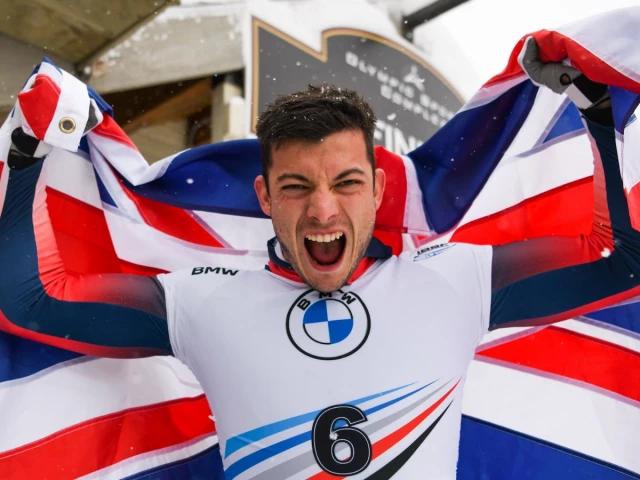
Matt Weston’s Olympic triumph was a moment of redemption and perseverance. The 28-year-old British athlete’s journey, marked by two broken backs—one ending his promising taekwondo career and another leading him to skeleton, demonstrated an extraordinary transformation in sports.
For many years after the first injury, which left him partially paralyzed, Weston’s prospects looked bleak until he discovered skeleton. It was initially seen as a quirky pastime at first glance—a thrilling but expensive sport that involved hurling oneself headfirst down a frozen track at breakneck speeds. Yet, this unconventional pursuit became his life’s passion and brought him global acclaim.
Weston’s journey back to competitive form after a second spinal fracture in 2016 was an even steeper challenge. He dedicated himself fully, eventually claiming two world championships and securing the top spot on the World Cup standings. However, his breakthrough victory came four years later during the Pyeongchang Winter Games.
The fact that he made history as only the third British man to claim a gold medal in skeleton since 1980 felt especially bittersweet for Weston. His previous attempt at Olympic glory had been so disappointing he nearly quit the sport.
“Meaning everything,” he declared, wiping away tears. “It was all about my family and friends who have sacrificed so much for me to be here.”
His fiancée Alex Howard-Jones and parents Alison and Tom were among those celebrating his victory. For the next few months, Weston admitted that this could very well be his happiest day.
Weston’s teammates recognized him as “Captain 110%,” a nickname he earned through his unwavering dedication to winning at all costs. He joked about being an incessant perfectionist in other areas of life, like Monopoly.
Winning was more than just personal glory for Weston; it represented the success of Britain’s skeleton program. Over the years, British athletes have brought home a total of four gold, one silver, and five bronze medals in skeleton alone, despite lacking proper ice tracks. Their achievements were partly funded by £5 million ($6.9 million) allocated specifically to Olympic preparations.
Weston’s path wasn’t an easy one. He had to endure rigorous mental and physical training at the elite Royal Marines before transitioning into skeleton. While critics might consider his sport as seemingly passive, Weston maintained that any appearance of inactivity concealed intense effort. “It looks like I am lying there doing nothing, but I am doing everything right,” he explained.
In essence, Matt Weston’s Olympic gold medal crowned a remarkable turnaround for Britain’s skeleton program, highlighting their unique contribution to the Winter Olympics through sheer determination and innovation.
The Aga Khan University's (AKU) Centre for Innovation in Medical Education (CIME), Karachi, hosted SIMPACT…
Meezan Bank, Pakistan's premier Islamic bank, once again partnered with The Indus Hospital & Health…
Pakistan’s leading digital microfinance bank, Mobilink Bank, and Yango, part of the global technology company…
Pakistan’s freelancing market is rapidly emerging, and the export earnings of Pakistani freelancers are expected…
To celebrate the release of Atif Aslam’s highly anticipated new album, Subah Aye Na, Spotify…
KARACHI: Supernet Technologies Limited (STL) is looking to strengthen its working-capital capacity as a growing…
This website uses cookies.
