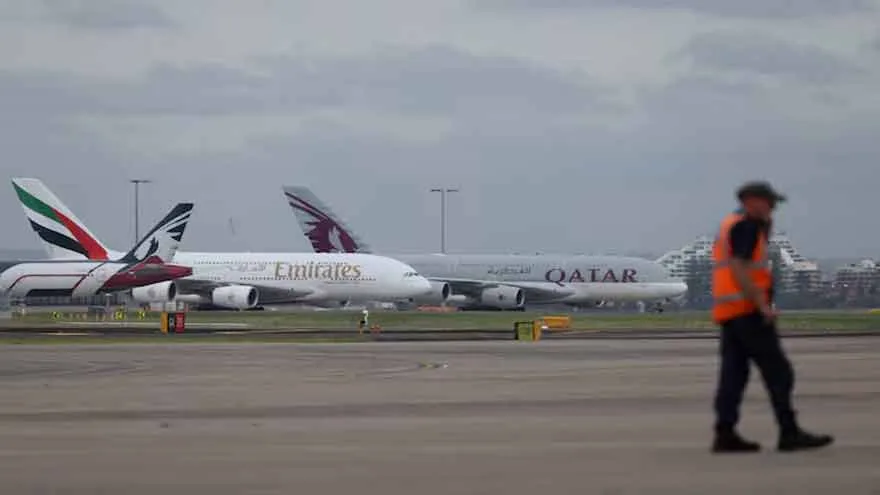
Middle Eastern airlines recorded their lowest flight volumes in over a week due to Iranian drone attacks across the Gulf. These attacks followed initial strikes on Iran by US and Israeli forces late February, disrupting networks of major carriers like Emirates, Etihad Airways, flydubai, Qatar Airways, and Air Arabia.
Since then, flights from key hubs in the United Arab Emirates have slowly increased but remain below pre-conflict levels. This recovery was halted Monday when drone attacks forced diversions to Muscat in Oman or Riyadh in Saudi Arabia, disrupting inbound aircraft over Saudi Arabia.
Etihad and Qatar Airways experienced the steepest drops, with Air Arabia and Etihad’s volumes at about 60% of February levels, while Qatar Airways and flydubai are down to 51%. The conflict has also affected jet fuel prices, airline schedules across Europe and Asia, and forced airlines to warehouse jets or make lengthy “flights to nowhere.”
Despite these challenges, Emirates reported a record full-year net profit and remains resilient. However, other carriers like Qantas Airways, Lufthansa, and Virgin Atlantic have warned of escalating costs, potential grounding of planes, and supply crunches due to fuel shortages caused by the conflict.
The Aga Khan University's (AKU) Centre for Innovation in Medical Education (CIME), Karachi, hosted SIMPACT…
Meezan Bank, Pakistan's premier Islamic bank, once again partnered with The Indus Hospital & Health…
Pakistan’s leading digital microfinance bank, Mobilink Bank, and Yango, part of the global technology company…
Pakistan’s freelancing market is rapidly emerging, and the export earnings of Pakistani freelancers are expected…
To celebrate the release of Atif Aslam’s highly anticipated new album, Subah Aye Na, Spotify…
KARACHI: Supernet Technologies Limited (STL) is looking to strengthen its working-capital capacity as a growing…
This website uses cookies.
