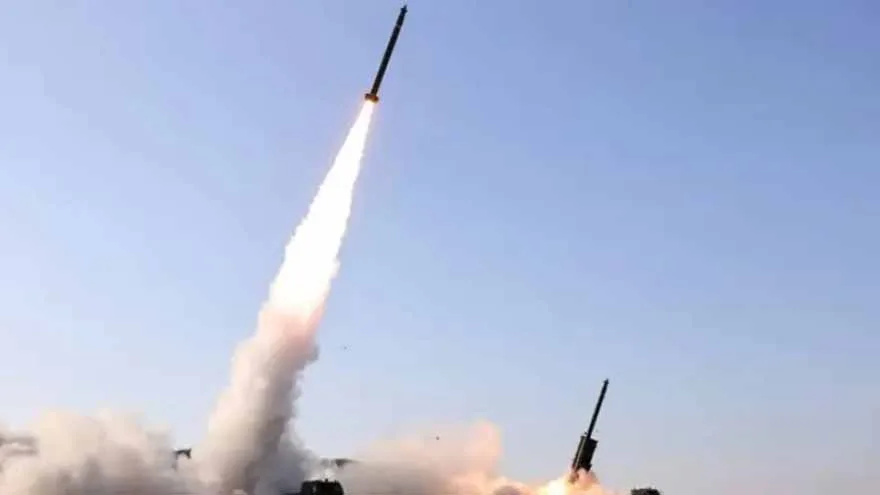
North Korea has tested a new cluster-bomb warhead on a ballistic missile and an electromagnetic weapon. This move is seen as part of efforts by Pyongyang to showcase its capacity for modern warfare.
The tests, conducted by the country’s Academy of Defence Science and Missile Administration, include carbon-fibre bombs and a mobile short-range anti-aircraft missile system. Kim Jong Sik, who oversaw the tests, described the electromagnetic weapon system and carbon-fibre bombs as “special assets” for North Korea’s military.
South Korea’s Joint Chiefs of Staff reported that Pyongyang had test-fired multiple missiles over several days. Analysts view these tests as a show of force in cutting-edge conventional weapon systems by the nuclear-armed North to its adversaries and allies.
Chinese Foreign Minister Wang Yi is scheduled to make a two-day visit to North Korea starting on Thursday. There has also been speculation that US President Donald Trump may hold a summit with North Korean leader Kim Jong Un during his visit to China in mid-May.
North Korea said it tested its mobile short-range anti-aircraft missile system and the combat capabilities of its tactical ballistic missile warhead, which is tipped with a cluster-bomb warhead. One test proved that the surface-to-surface tactical ballistic missile called Hwasongpho-11 Ka could “reduce to ashes any target” covering an area of up to 7 hectares (17 acres).
The tests also follow North Korea reiterating its characterization of South Korea as a “hostile enemy,” dashing recent hopes in Seoul for easing tensions on the Korean Peninsula. Experts believe that North Korea is upgrading its weapon system with cutting-edge technology suited for modern warfare.
An electromagnetic weapon system could have the capacity to disable electronic circuits in the enemy’s assets, potentially crippling South Korea’s F-35A stealth fighter jet or Aegis-equipped destroyers. Carbon-fibre bombs, developed by advanced militaries such as the US and China, are capable of crippling infrastructure like power plants by sprinkling conductive strands of carbon fibre over a target.
North Korea also conducted a firing drill using “low-cost raw materials,” indicating its focus on mass-producing weapons. This development would complicate South Korea’s defence strategy against North Korean threats. Experts say that North Korea is developing these weapons with an asymmetric warfare model in mind, focusing on disrupting power grids and industrial infrastructure.
The Aga Khan University's (AKU) Centre for Innovation in Medical Education (CIME), Karachi, hosted SIMPACT…
Meezan Bank, Pakistan's premier Islamic bank, once again partnered with The Indus Hospital & Health…
Pakistan’s leading digital microfinance bank, Mobilink Bank, and Yango, part of the global technology company…
Pakistan’s freelancing market is rapidly emerging, and the export earnings of Pakistani freelancers are expected…
To celebrate the release of Atif Aslam’s highly anticipated new album, Subah Aye Na, Spotify…
KARACHI: Supernet Technologies Limited (STL) is looking to strengthen its working-capital capacity as a growing…
This website uses cookies.
