Pakistan’s Solar Boom Shields Country from Energy Crises
The closure of the Strait of Hormuz has been mitigated by Pakistan’s rapid growth in rooftop solar installations. According to an analysis published by Renewables First and the Centre for Research on Energy and Clean Air, without this distributed solar growth, Pakistan would have faced significant supply disruptions and price shocks.
Since 2018, Pakistan has avoided over $12 billion in oil and gas imports that were needed to meet domestic energy demand. This shift represents not just fiscal relief but also a reduction in geopolitical risk exposure, according to the study.
The analysis predicts that by year-end, Pakistan could save an additional $6.3 billion due to solar adoption. Despite this progress, the Strait of Hormuz remains crucial for Pakistan’s energy needs, ranking third globally for LNG dependence on transit routes and fifth for oil imports.
However, rapid solarization has reduced reliance on imported energy. The study notes that long-term LNG contracts have seen some shipments diverted to international markets as demand for imported gas decreases due to distributed solar installations.
The government has implemented measures to ration fuel amid the Strait of Hormuz closure, with a recent briefing indicating Pakistan would run out of LNG by April 14 due to Qatar’s supply suspension.
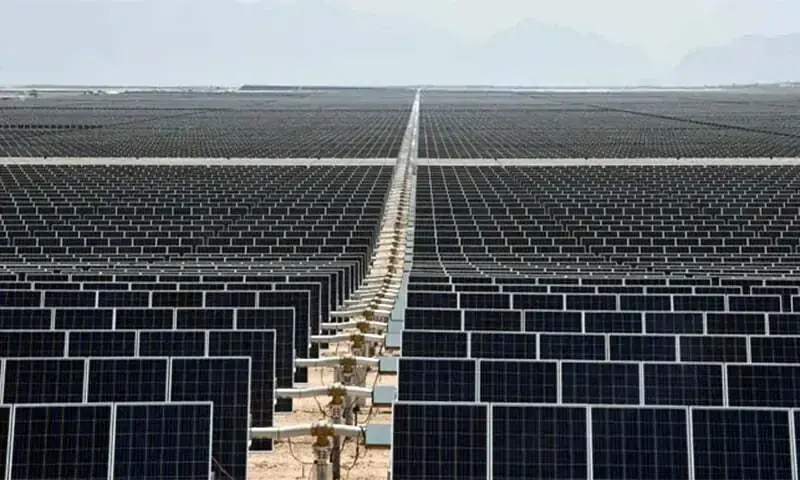
Pakistan’s solar revolution was driven by market forces and consumer adoption rather than state planning. The government maintained a zero-rated tax regime on solar PV imports, boosting such imports from under 1GW in 2018 to over 51GW by early 2026.
The 2022 energy crisis, following the Ukraine invasion and falling costs of solar manufacturing in China, catalyzed this surge. Since then, Pakistan has seen a significant drop in oil and gas imports between 2022 and 2024.
Lauri Myllyvirta from the Centre for Research on Energy and Clean Air noted that Pakistan’s solar boom acts as an insurance policy against energy shocks. The study also highlighted that renewables offer the lowest-cost path to energy access, with every gigawatt of distributed solar deployed serving as a hedge against the global energy crisis.
The Aga Khan University's (AKU) Centre for Innovation in Medical Education (CIME), Karachi, hosted SIMPACT…
Meezan Bank, Pakistan's premier Islamic bank, once again partnered with The Indus Hospital & Health…
Pakistan’s leading digital microfinance bank, Mobilink Bank, and Yango, part of the global technology company…
Pakistan’s freelancing market is rapidly emerging, and the export earnings of Pakistani freelancers are expected…
To celebrate the release of Atif Aslam’s highly anticipated new album, Subah Aye Na, Spotify…
KARACHI: Supernet Technologies Limited (STL) is looking to strengthen its working-capital capacity as a growing…
This website uses cookies.
