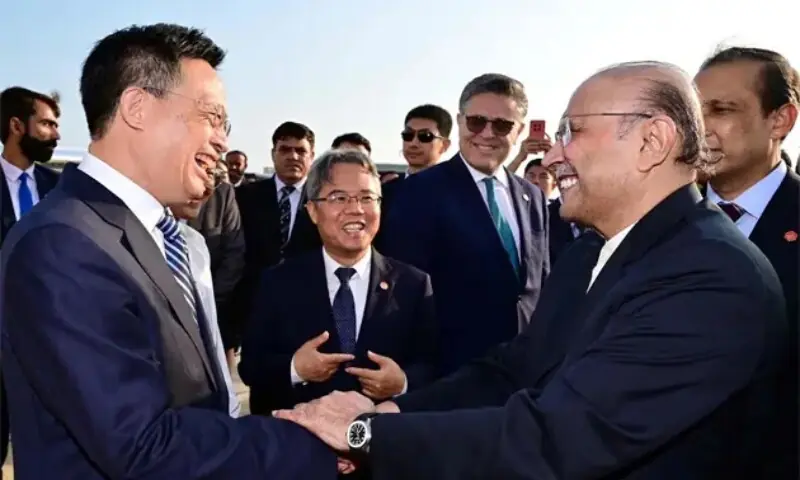
President Asif Ali Zardari’s recent visit to China reflects the continuity and forward movement of Pakistan’s most consequential strategic partnership. At a time of shifting global alignments and regional uncertainty, the visit reinforced a clear direction: strengthening long-term cooperation, deepening economic integration, and expanding strategic capabilities across multiple domains.
The timing was significant. Marking 75 years of diplomatic relations between Pakistan and China, the visit went beyond symbolism. It provided an opportunity to consolidate an already deep partnership and advance it into its next phase — one defined less by foundational infrastructure and more by industrial cooperation, technological exchange, and strategic alignment.
While economic engagement formed an important pillar of the visit, one of its most consequential outcomes lay in the domain of defence cooperation.
The President’s presence at the commissioning of the Hangor-class submarines marked a major milestone in Pakistan–China naval collaboration. Equipped with advanced systems and enhanced endurance capabilities, these submarines significantly strengthen Pakistan’s underwater deterrence and maritime security framework.
This development sits within the broader trajectory of deepening China–Pakistan defence cooperation, which has gained renewed operational relevance amid recent regional tensions. The performance and deployment visibility of platforms such as the J-10C fighter aircraft and other Chinese defence technology have highlighted the growing interoperability and maturity of this partnership at the military level. Together with naval advancements like the Hangor-class submarines, these capabilities reflect a defence relationship that is increasingly integrated and strategically consequential.
In a region where maritime security is becoming increasingly contested—particularly given instability in the wider Middle East and shifting dynamics along critical sea lanes—Pakistan’s ability to secure its maritime routes has taken on heightened importance. For a country whose economy depends heavily on uninterrupted trade flows, strengthening deterrence and maritime readiness has become a strategic necessity.
Another geopolitical layer ties these strands together. The visit comes at a time when global supply chains are under stress. In such an environment, alternative trade corridors are gaining immediate relevance. Gwadar Port is already seeing increased activity as a potential transshipment hub, with estimates suggesting it could contribute several billion dollars to Pakistan’s economy.
As for the economic aspect, Pakistan’s most immediate challenge is not political visibility but economic expansion. Foreign investment remains constrained not due to a lack of opportunity, but due to limited high-level engagement. President Zardari’s outreach operates precisely in that space—leveraging personal diplomacy to open doors that formal channels often cannot.
On the economic side, the visit also produced multiple Memorandums of Understanding across sectors including water management, agriculture, industrial cooperation, and technology. These agreements reflect a practical expansion of bilateral engagement, with a growing focus on productivity, structural resilience, and long-term economic transformation.
The focus on the second phase of CPEC reinforces this shift. Pakistan is moving from infrastructure build-out to economic activation—industrialization, agricultural modernization, and digital connectivity. Special Economic Zones (SEZs) are central to this transition. The Khairpur Economic Zone, developed by the Sindh Government, already provides a working model, having been ranked among South Asia’s best and third globally by the Financial Times in 2025–26. This is execution, not theory, and scaling it requires precisely the kind of engagement this visit represents.
Crucially, President Zardari’s outreach was not limited to traditional sectors. One of the more under-discussed but strategically significant areas explored during the visit is the tea industry—a sector that clearly illustrates Pakistan’s structural economic imbalance.
Pakistan is among the world’s largest consumers of tea, yet remains almost entirely dependent on imports. In 2024–25 alone, the country spent approximately $629 million importing over 246,000 metric tons of tea. What makes this more concerning is that Pakistan has the capacity to change this equation, as multiple studies have identified nearly 270,000 hectares of land suitable for tea cultivation.
China is not just a trading partner—it is a global leader in agricultural scaling, processing infrastructure, and value-chain integration. Collaboration in this sector could help Pakistan move from import dependency to partial self-sufficiency, while also creating rural employment and reducing pressure on the current account. The message is simple: economic diplomacy today is not sector-specific—it is system-wide.
President Zardari’s visit also reflects a calibrated balancing act. Pakistan’s engagement with the United States, including its role in facilitating dialogue with Iran, remains important. However, maintaining strategic depth with China ensures that Pakistan is not locked into a single axis. This is not about choosing sides; it is about securing space in a multipolar world.
The symbolic elements reinforce this depth. President Zardari’s visit to Changsha, the birthplace of the Chinese Communist Party, reflects continuity in party-to-party relations—particularly between the PPP and the CCP. These relationships matter because they build trust, and trust accelerates outcomes.
Ultimately, this visit was far from routine diplomacy. It is a multi-layered strategic move, economic, geopolitical, and military. From industrial zones to tea fields, and from supply chains to submarines, the direction is consistent: Pakistan is positioning itself to secure both its economic future and its strategic autonomy.
The book-building portion of SE Fruits and Vegetable Limited’s Initial Public Offering (IPO) was fully…
The two-day book-building process for the Initial Public Offering (IPO) of SE Fruits and Vegetable…
Karachi, September 21: Engro Holdings Limited (“Engro Holdings”) today announced that the Board of Directors…
Karachi, September 20, 2026: The inauguration of the September SNIDs (Sub-National Immunization Days) for polio…
Al-Ghazi Tractors Limited (AGTL) unveiled two new additions to its New Holland tractor portfolio, the…
St. Petersburg, Russia: Pakistan’s seafood industry continues to make its mark on the global map,…
This website uses cookies.
