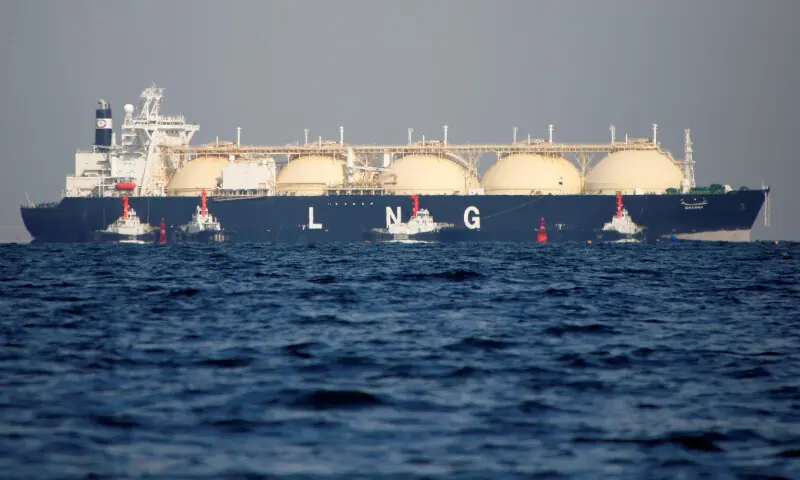
Qatar anticipates all Gulf energy producers may be forced into shutting down exports within weeks if Iran’s conflict with Israel and the US continues, leading to oil surges as high as $150 a barrel. This could have severe impacts on global economies.
The country’s Energy Minister Saad al-Kaabi revealed this perspective in an interview published by The Financial Times on Friday. Qatar already halted its production of liquefied natural gas (LNG) on Monday, in response to ongoing Iranian strikes against Gulf countries due to Israel and US attacks.
Qatar’s LNG output accounts for approximately 20% of global supply and is crucial for balancing Asian and European markets’ demand for this fuel type. Al-Kaabi predicted that if the conflict persists, “Everyone who has not already called for force majeure will do so within a few days.” He emphasized that all Gulf region exporters would need to declare force majeure in similar circumstances.
The potential impacts are dire according to al-Kaabi. “If this war continues for several weeks, global GDP growth is going to be affected,” he stated. He also predicted an increase in energy prices across the board, leading to product shortages and factory production halts as markets struggle to meet demand.
Al-Kaabi, CEO of QatarEnergy—the world’s largest LNG producer—expressed further concerns that even if hostilities cease immediately, recovery from such a disruption could take “weeks to months.” Analysts and economists have identified the war’s global repercussions with significant accuracy.
Regarding a key project by his company, North Field expansion, al-Kaabi explained its delay may be extended to anywhere between one week and two or three months. The initial production start was planned for mid-2026 but faces postponement due to current events.
He also projected that crude prices could reach $150 a barrel within the next two to three weeks if shipping and tanker operations are impeded in the Strait of Hormuz, which acts as a crucial gateway connecting major Gulf oil producers with the Arabian Sea.
Similarly, al-Kaabi forecasted gas prices would surge to $40 per million British thermal units (Btu). These predictions underscore Qatar’s urgent need for global stability amid ongoing conflicts and their far-reaching economic consequences.
Iranian Life Amidst US-Israel War The ongoing conflict between the US and Israel has exacerbated…
The U.N. Human Rights Council held an emergency debate on Friday to discuss a fatal…
Fatima Fertilizer Company Limited, Pakistan’s leading fertilizer manufacturers, announced its partnership with the Multan Sultans…
Air travel affected by Middle East tensions shows signs of recovery. Qatar Airways begins expanding…
Punjab Government Announces Holiday for Mela Chiraghan The Punjab government has declared March 28 as…
BTS has released their Netflix documentary "BTS: The Return," marking their official comeback since military…
This website uses cookies.
