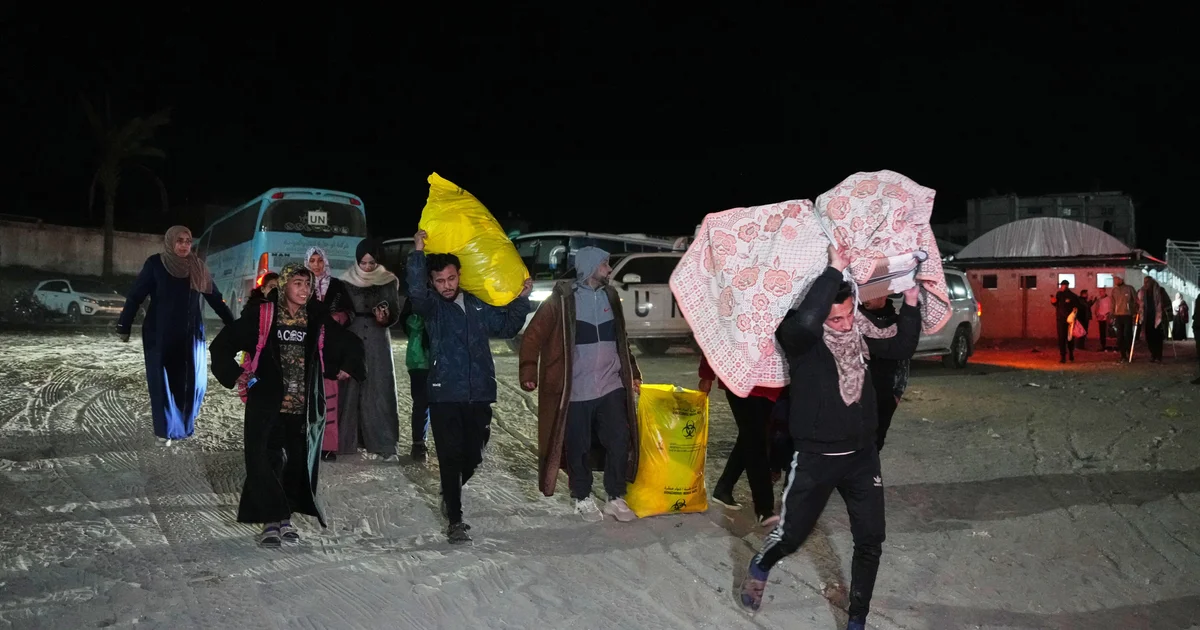
A limited number of Palestinians managed to cross between Gaza and Egypt on Sunday following a brief reopening of the critical border point. Despite opening last week for the first time since 2024 amid support from the U.S., the Rafah crossing faced initial confusion and was closed over Friday and Saturday.
Egyptian state media reported that Palestinians began crossing in both directions around noon, though Israeli officials did not immediately confirm these reports. Meanwhile, Egypt is preparing to receive another group of Palestinians seeking medical treatment at Egyptian hospitals.
Israeli Prime Minister Benjamin Netanyahu is expected to visit Washington this week, where his discussions will focus on Iran rather than the ongoing situation in Gaza. This has come as a relief for many Gazans who have been waiting for the crossing’s reopening, which promises essential access to healthcare not available within the war-torn territory.
For some Palestinians, it was their first opportunity to seek critical medical care outside of Gaza. Amjad Abu Jedian, one such patient, had his scheduled trip delayed by only five other patients on the first day of operations. His mother, Raja Abu Jedian, described her son’s injuries and how he narrowly avoided death at the hands of an Israeli sniper while constructing traditional bathrooms in the Bureij refugee camp.
Despite initial reports suggesting just 36 Palestinians were allowed through during the crossing’s inaugural days, United Nations data indicates that nearly 20,000 Gazans are seeking similar medical care but face significant challenges. Patients have reported long delays and allegations of mistreatment by both Israeli forces and Palestinian groups overseeing the crossing.
A small group of Palestinians also arrived Sunday morning at the Egyptian side of the Rafah border, bringing back their compatriots from the Gaza Strip. Yet even those returning faced hours-long queues and invasive searches conducted by Israeli security personnel and Abu Shabab—a pro-Palestinian armed group supported by Israel.
The reopening of the crossing marked a crucial step in the recent ceasefire agreement that ended nearly two years of conflict between Israel and Hamas. However, strict controls on traffic direction and medical patients have significantly limited its effectiveness as a lifeline for Gazans seeking outside care. Despite initial hopes, the Rafah crossing remains an essential yet vulnerable conduit for Palestinians desperate to access critical healthcare.
The Israeli Defense Forces (IDF) oversees security operations at the border crossing but is positioned some distance from it. Coordination between Israeli officials and international partners has led to restrictions on how many individuals can cross daily—a stark contrast from the symbolic reopening when traffic was initially expected to be minimal.
For decades, Palestinians have relied on Rafah as their sole entry point into Egypt. However, Israel seized control of the Gaza-side crossing in May 2024, limiting its use even before then. This ongoing dispute continues to underscore the complexities surrounding Palestinian access to healthcare and humanitarian aid in the midst of war.
A second humanitarian aid flotilla is set to depart from Barcelona, Spain, carrying medical supplies…
Tyson Fury, the heavyweight boxer, has spoken about a personal loss that occurred just days…
Justin Bieber made a significant splash as he headlined Coachella for the first time. Pop…
Pakistan Announces Expansion of Petroleum Storage Amid Saudi Investment Pakistan's decision to expand petroleum storage…
Savannah Guthrie returned to the Today show on April 6. She was issued a 'secret…
Iran's senior oil official says most damaged refining and distribution facilities will return to 70-80%…
This website uses cookies.
