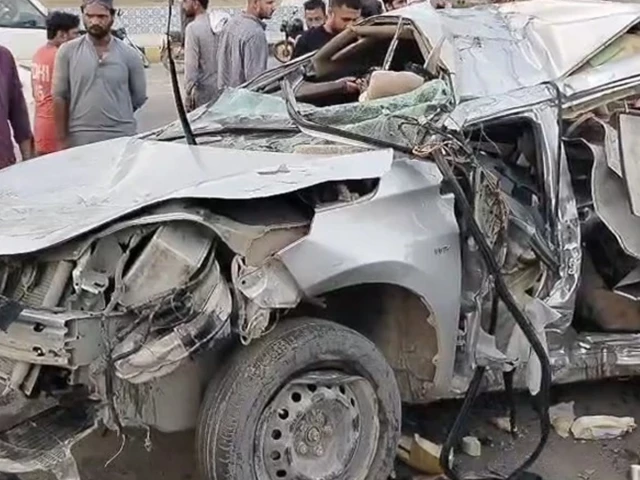
The Sindh government has introduced mandatory third-party vehicle insurance with fixed payouts designed to mitigate financial distress for accident victims. Effective immediately, all vehicles operating within the province must carry third-party insurance, which will cover injuries or fatalities of passengers in insured vehicles. Previously, only vehicle-specific insurance was compulsory, providing compensation solely to vehicle owners.
Under this new measure, affected individuals and their legal heirs will no longer need to seek court intervention for damages; instead, the relevant insurance company will make payments without the need for litigation. Deputy Director Jamshed Memon of Sindh’s Motor Registration Wing confirmed that the government has mandated third-party insurance as a prerequisite for vehicle operation.
A Sindh Police official underscored the importance of this amendment by highlighting significant increases in compensation rates for passengers involved in accidents. The Provincial Motor Vehicles (Amendment) Bill 2026, recently passed by the Sindh Assembly, specifies detailed compensation scales for various injuries and fatalities. For instance, Rs700,000 is payable to heirs if a person dies, while compensation of Rs500,000 covers one or both hands, arms, legs, or eyes. Losses involving specific body parts receive different amounts: the right-hand thumb will be compensated at Rs150,000, the left-hand thumb at Rs100,000, and a right-hand finger at Rs100,000, whereas a left-hand finger loss garners Rs75,000. The lowest compensation is set at Rs30,000 for the big toe.
The new insurance framework differs from systems in other countries where compensation rates vary based on local conditions and severity of injury. Japan offers high compensation—Rs200,000 for death and Rs270,000 for severe injury or permanent disability. Authorities there assess individual injuries to determine the extent of impairment and its impact on earning potential, thereby setting higher compensation levels.
Local lawyer Muhammad Ali Sarang pointed out that in developed nations like Japan, compensation differs between right and left sides due to variations in daily reliance. Injuries to the right hand or foot are considered more critical because most people rely more heavily on these limbs for tasks and employment.
Dr Muhammad Bakhsh from Jinnah Postgraduate Medical Centre noted that many countries do not differentiate compensation based on whether an injury affects the right or left side of a body part, attributing this difference to cultural practices. However, in regions where such distinctions are made, it reflects the practical differences between use and economic reliance.
In conclusion, while Sindh’s new third-party insurance model aims to address financial hardships for accident victims, its fixed payouts fail to account for individual injuries’ varying impacts on one’s livelihood and medical needs. Such omissions underscore the need for more nuanced compensation systems tailored to local contexts.
Andrew Mountbatten Windsor, formerly known as the Duke of York, has been instructed to minimize…
Alex Duong, renowned comedian and actor, died at 42 after battling cancer for a year.…
Female drug addiction remains a largely hidden crisis despite growing awareness of women's rights and…
Taylor Swift Attends Paul McCartney Concert On March 28, Taylor Swift attended a concert by…
Andrew Mountbatten-Windsor's public disgrace since Virginia Giuffre first accused him has escalated into legal troubles…
Kanye West's latest album, Bully, has taken the music charts by storm. According to Spotify…
This website uses cookies.
