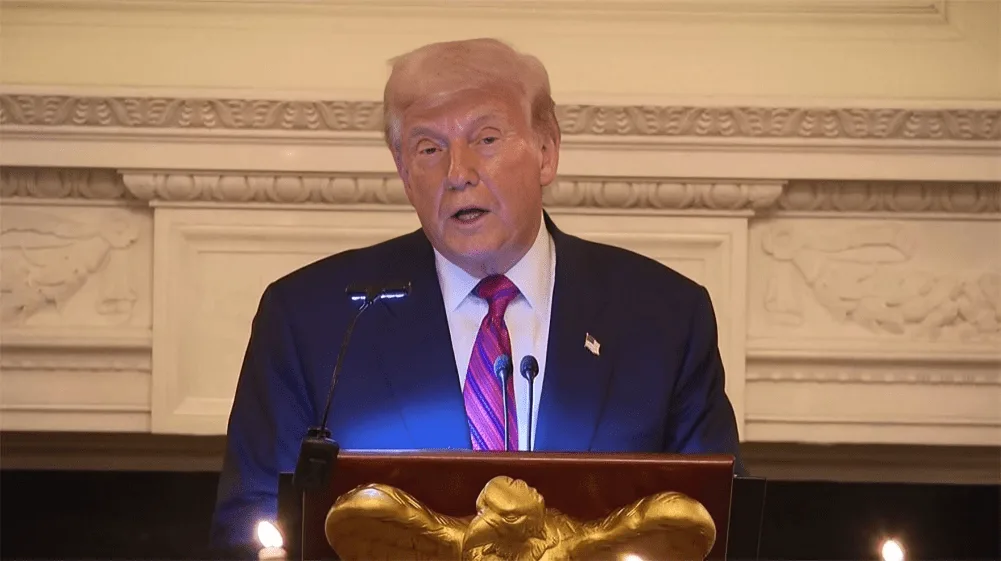
U.S. President Donald Trump said up to five fighter jets were brought down during the recent military confrontation between India and Pakistan, which followed an April attack in Indian-administered Kashmir and escalated until a ceasefire was brokered in May.
Speaking during a dinner with Republican lawmakers at the White House, Trump recounted the high-stakes encounter between the two nuclear-armed neighbours. “In fact, planes were being shot out of the air. Five, five, four or five, but I think five jets were shot down actually,” he said, without clarifying which country’s aircraft he was referencing or offering further details.
The hostilities erupted after New Delhi accused Islamabad of involvement in an Islamist militant attack in Pahalgam. Pakistan denied any role and rejected the allegations, insisting it was not responsible and offering cooperation for an independent investigation.
India responded with aerial strikes on Pakistani territory in early May, prompting a counterattack from Pakistan’s air force, which claimed it had downed five Indian jets, later updating the number to six. According to Pakistan, the strikes targeted Indian military sites after three of its own air bases were hit.
India’s military leadership later acknowledged that early aerial losses forced a change in operational strategy. By the end of the three-day conflict, India claimed it had regained the upper hand and had downed multiple Pakistani jets — a claim firmly denied by Islamabad, which maintained that it suffered no aircraft losses.
“It was getting worse and worse, wasn’t it?” Trump said. “These are two serious nuclear countries and they were hitting each other. It seems like a new form of warfare; you saw it recently, when you looked at what we did in Iran when we knocked out their nuclear capability, totally knocked out,” he added, referring to recent U.S. airstrikes on Iranian nuclear infrastructure.
The three-day exchange, marked by air raids and missile strikes on military installations, came to a halt on May 10, after the U.S. intervened diplomatically. Trump has since repeatedly asserted that it was American pressure that prevented the crisis from spiraling into nuclear war.
He also credited Pakistan’s Chief of Army Staff, Field Marshal Asim Munir, for assisting in de-escalation efforts. However, Indian officials have dismissed Trump’s narrative, pushing back against claims that the ceasefire resulted from U.S. mediation, and criticized what they saw as threats to suspend bilateral trade talks.
This post was last modified on July 19, 2025 1:37 pm
KARACHI - The Muttahida Qaumi Movement (MQM) is urging political parties to implement the 28th…
Emma Slater has addressed rumors about her leaving Dancing with the Stars during an appearance…
Global inflation is impacting Japan's traditional "hanami" cherry blossom picnics, according to a report by…
European Union chief Ursula von der Leyen visited Australia amid global trade uncertainty. The bloc…
Canada's Federal Minimum Wage Set to Rise The Canadian government announced on Tuesday that it…
US President Donald Trump backed away from his threat to bomb Iranian energy facilities on…
This website uses cookies.
