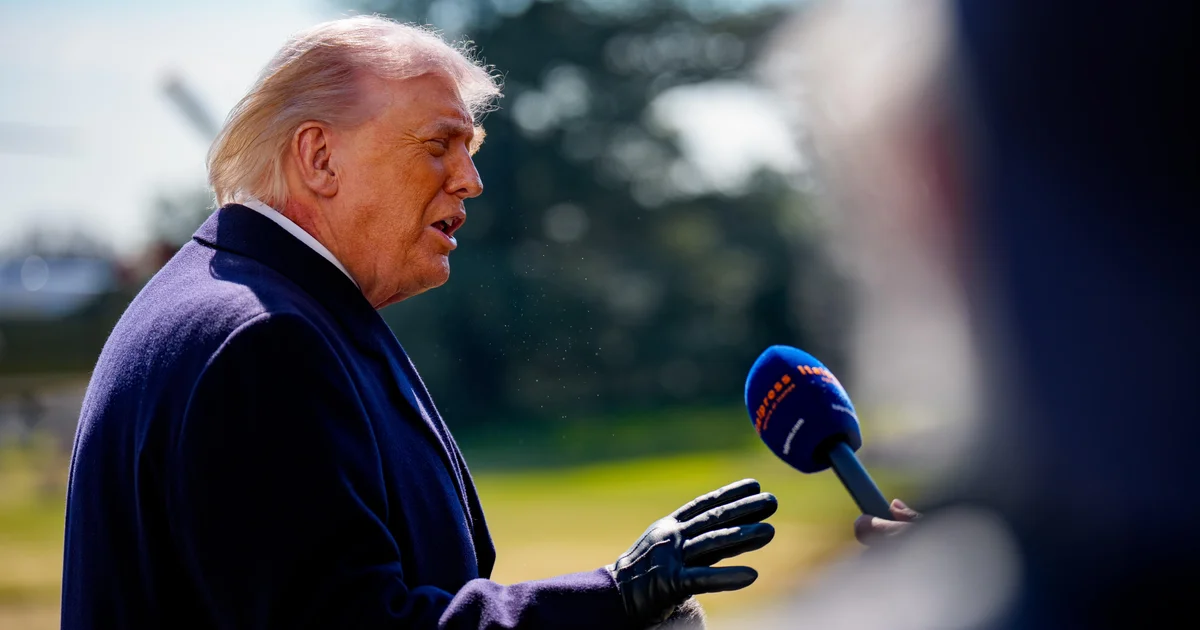
WASHINGTON — President Donald Trump expressed renewed frustration Friday over the slow pace of negotiations with Iran regarding its nuclear program, as tensions in the Middle East continued to escalate amid the administration’s deployment of military assets.
In remarks to reporters prior to departing for Texas where he will speak on energy policy, Mr. Trump said that although he had not yet made a decision on whether to authorize strikes against Iran, his current stance was one of unhappiness with how negotiations were proceeding. “I’m not happy with the fact they’re not willing to give us what we have to have,” he acknowledged. “I’m not thrilled with that.”
Mr. Trump underscored the potential risks associated with a prolonged military conflict and reiterated his firm belief in Iran’s inability to possess nuclear weapons: “We cannot allow Iran to get a nuclear weapon, and there is always a risk of a drawn-out war.” Despite this position, he indicated readiness to use force if necessary: “There’s nothing close to our military. I’d love not to have to use it, but sometimes you do.”
U.S. special envoys Steve Witkoff and Jared Kushner met with Iranian negotiators in Geneva on Thursday, brokered by Oman, as part of ongoing discussions aimed at averting a potential U.S. military strike. Middle Eastern countries warned that strikes could trigger a significant international conflict, to which the president responded by assembling his forces—a naval “armada” comprising military jets, two aircraft carriers, and guided-missile destroyers—into the region.
The State Department authorized non-emergency personnel and their families to evacuate Israel due to security concerns. Secretary of State Marco Rubio is scheduled to visit the country in coming days to address a range of regional priorities, including Iran.
Neither White House officials nor Witkoff and Kushner provided any details on the specifics of Thursday’s talks in Geneva. Iranian Foreign Minister Abbas Araghchi claimed that “there was perhaps more seriousness” between both sides, aiming for a negotiated solution with another round of talks slated for next week.
Vice President JD Vance told The Washington Post that Mr. Trump remains committed to strikes as a last resort to prevent Iran from acquiring nuclear arms but admitted that the United States would not engage in a long-term conflict “with no end in sight.”
The ongoing negotiations between the U.S. and Tehran come shortly after June’s airstrikes targeting Iranian nuclear facilities, where Mr. Trump asserted these “obliterated” Iran’s program. Yet, he insisted on maintaining diplomatic efforts: “My preference is to solve this through diplomacy,” he said during his State of the Union address.
Despite differences in approach between the administration and some officials such as Vice President JD Vance, there was no sign of a change in Mr. Trump’s determination to prevent Iran from acquiring nuclear weapons, declaring it a top priority: “I will never allow the world’s number one sponsor of terror—which they are by far—to have a nuclear weapon.”
Kathryn Watson and Tucker Reals contributed to this report.
The Aga Khan University's (AKU) Centre for Innovation in Medical Education (CIME), Karachi, hosted SIMPACT…
Meezan Bank, Pakistan's premier Islamic bank, once again partnered with The Indus Hospital & Health…
Pakistan’s leading digital microfinance bank, Mobilink Bank, and Yango, part of the global technology company…
Pakistan’s freelancing market is rapidly emerging, and the export earnings of Pakistani freelancers are expected…
To celebrate the release of Atif Aslam’s highly anticipated new album, Subah Aye Na, Spotify…
KARACHI: Supernet Technologies Limited (STL) is looking to strengthen its working-capital capacity as a growing…
This website uses cookies.
