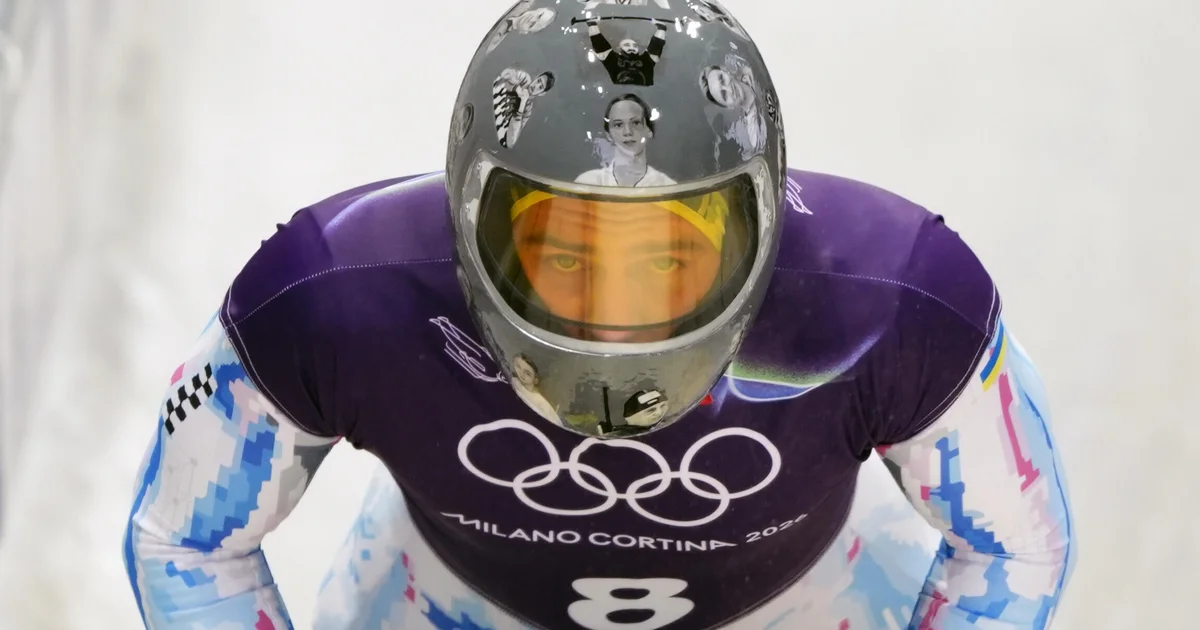
Cortina d’Ampezzo, Italy — As Ukraine’s Olympic skeleton athlete Vladyslav Heraskevych prepared to compete in the Milan-Cortina Games this week, he found himself at a crossroads between his personal values and the rules governing international sports competitions. The stakes were high as Heraskevych faced a critical decision about how to honor fellow Ukrainians lost during Russia’s war on Ukraine while competing under the Olympic banner.
Heraskevych had crafted an iconic helmet for his skeleton race at the 2022 Beijing Games, emblazoned with more than 20 faces representing Ukrainian athletes and coaches killed in combat. But as the Milan-Cortina Games began, Heraskevych found himself at a predicament. The International Olympic Committee (IOC) had issued a strict directive: the helmet was not permitted on the field of play.
The IOC’s decision came amid intense scrutiny from both sides—Heraskevych and his supporters, who saw it as a matter of honoring their fallen compatriots; and the IOC, which maintained that such displays could undermine the spirit of Olympic neutrality. Heraskevych refused to yield, despite multiple meetings with IOC officials where he had expressed his desire to remember those lost in Ukraine’s war.
On Thursday morning, just hours before the start of the men’s skeleton race, a private meeting took place at the top of the track. IOC President Kirsty Coventry waited anxiously for Heraskevych as the athlete made his way down the slope. The moment was tense; both sides knew this could be pivotal in deciding whether Heraskevych would run—or not.
“I think it’s really important to see him race,” Coventry told reporters after the meeting, her voice tinged with emotion. “It’s been an emotional morning.” She added, “No one, especially me, is disagreeing with the messaging behind this decision—remembrance and memory. But finding a respectful solution for the field of play has proven challenging.”
Heraskevych himself acknowledged the gravity of his situation in interviews afterward. “It’s hard to say or put into words,” he said during a press conference. “This is a price of our dignity.” His remarks were met with a mix of understanding and frustration from those who supported him, including Ukrainian artist Iryna Protts.
“I would be very upset if he wasn’t allowed to wear it,” she told CBS News’ Aidan Stretch in Kyiv. “It feels like hypocrisy when no one cares anymore. Everyone just looks on.”
The IOC’s stance was clear: the helmet violated the rules that govern political statements at the Olympics, which are meant to maintain a level playing field for all competitors regardless of origin or cause.
Despite their determination not to bend, Heraskevych remained firm in his decision. “We want him to compete,” IOC spokesman Mark Adams insisted during a press conference. “All athletes deserve their moment, and we believe that’s what this is about.”
As the race approached its climax, anticipation filled the air. The first two runs were scheduled for Thursday, followed by Heraskevych’s final chance in Friday night’s competition.
For many in Ukraine, seeing Heraskevych compete was seen as a symbol of hope and resilience amidst ongoing conflict. For those who supported him, this decision represented more than just sports; it underscored the broader struggle for remembrance and dignity during times of war. The final verdict would decide whether the message of honor and loss could be heard through the Olympic lens or remain silenced under its rules.
In the days that followed, Heraskevych’s story continued to captivate a global audience, reminding all of the delicate balance between individual pride and collective responsibility in the midst of conflict.
The Aga Khan University's (AKU) Centre for Innovation in Medical Education (CIME), Karachi, hosted SIMPACT…
Meezan Bank, Pakistan's premier Islamic bank, once again partnered with The Indus Hospital & Health…
Pakistan’s leading digital microfinance bank, Mobilink Bank, and Yango, part of the global technology company…
Pakistan’s freelancing market is rapidly emerging, and the export earnings of Pakistani freelancers are expected…
To celebrate the release of Atif Aslam’s highly anticipated new album, Subah Aye Na, Spotify…
KARACHI: Supernet Technologies Limited (STL) is looking to strengthen its working-capital capacity as a growing…
This website uses cookies.
