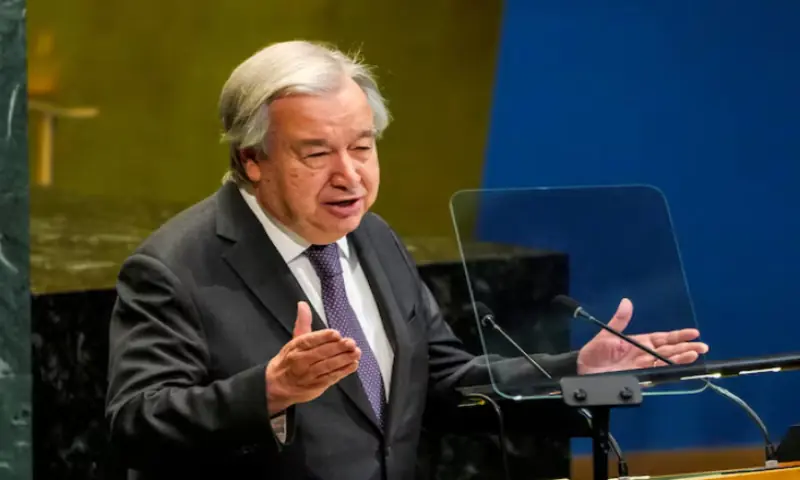
UN Secretary-General Antonio Guterres has penned a letter to UN Security Council members underscoring the necessity of maintaining a uniform UN presence in Lebanon post-UNIFIL’s mandate expiration at year-end.
Guterres outlined three options for replacing the 7,500-strong UNIFIL force. These range from a light presence with limited capabilities involving around 1,980 personnel to a more robust force with broader monitoring and de-escalation capabilities requiring up to 5,525 uniformed personnel.
The letter emphasized that under all proposed scenarios, a uniformed UN presence would be essential for supporting a strengthened UN political mission aimed at resolving the conflict in Lebanon. Guterres noted the situation has worsened since March and highlighted the need for credible observation along the Blue Line and up to the Litani River.
Option 1 envisions an unarmed military observer force of 350 personnel, bolstered by armed forces protection including four infantry battalions totaling 750 troops each and a reserve unit of 700. This option would have the capacity to most credibly observe developments along the entire length of the Blue Line and up to the Litani River.
Option 2 proposes an unarmed military observer force of 285 personnel, bolstered by armed forces protection including two infantry battalions totaling 750 troops each and a reserve unit of 450. This option would focus on monitoring the area between the Litani River and the Blue Line, with direct observation from static positions and patrols.
Option 3 suggests an unarmed military observer force of 215 personnel, bolstered by two light infantry battalions of 450 armed troops each and a quick reaction force of 350 for force protection. This option would monitor developments along the Blue Line and up to several kilometers north, including from critical static positions and through mobile observations.
However, Guterres pointed out that without necessary technological support, the entire Blue Line could not be continuously monitored, nor could there be capacity to place forces between Lebanese and Israeli sides to de-escalate tensions. Additionally, such a force would have limited ability to provide information on ceasefire violations. The letter also stressed that any future uniformed presence would require air assets for medical evacuations, as well as capacities for demining and engineering, along with enhanced monitoring through radar, helicopters, drones, and satellite imagery.
The Aga Khan University's (AKU) Centre for Innovation in Medical Education (CIME), Karachi, hosted SIMPACT…
Meezan Bank, Pakistan's premier Islamic bank, once again partnered with The Indus Hospital & Health…
Pakistan’s leading digital microfinance bank, Mobilink Bank, and Yango, part of the global technology company…
Pakistan’s freelancing market is rapidly emerging, and the export earnings of Pakistani freelancers are expected…
To celebrate the release of Atif Aslam’s highly anticipated new album, Subah Aye Na, Spotify…
KARACHI: Supernet Technologies Limited (STL) is looking to strengthen its working-capital capacity as a growing…
This website uses cookies.
