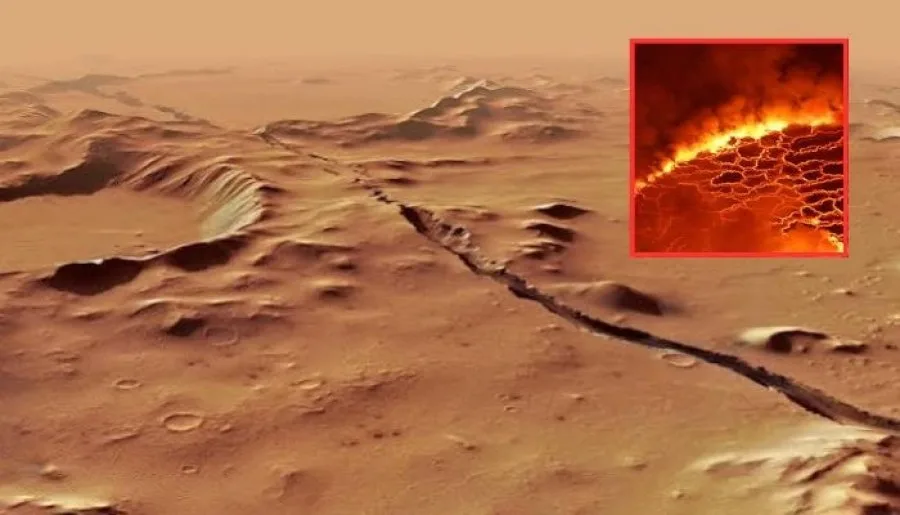
Scientists have made a significant discovery with vast hidden magma systems beneath Mars’ surface. This breakthrough, detailed in a study published in Nature Astronomy using data from NASA’s InSight mission, has implications for understanding alien life.
Researchers found that at 24 kilometers below the Martian surface, rock composition changes dramatically—from silica-rich “mafic” above to iron and magnesium-rich “ultramafic” below. This shift suggests Mars could host large, long-lived systems where molten rock evolves and reprocesses throughout its crust, challenging previous assumptions about volcanic activity on Mars.
Tobermory Mackay-Champion from Oxford University noted that this discovery raises intriguing possibilities for how common such systems might be on rocky planets beyond our solar system. The findings also support the idea that Mars could sustain long-lived systems with molten rock reprocessing itself through its crust, increasing the likelihood of finding evidence for alien life.
One key takeaway is that if Mars can develop a complex crust without plate tectonics, it suggests habitable conditions might exist on other planets previously considered unsuitable due to their size or lack of tectonic activity.
Meezan Bank, Pakistan's premier Islamic bank, once again partnered with The Indus Hospital & Health…
Pakistan’s leading digital microfinance bank, Mobilink Bank, and Yango, part of the global technology company…
Pakistan’s freelancing market is rapidly emerging, and the export earnings of Pakistani freelancers are expected…
To celebrate the release of Atif Aslam’s highly anticipated new album, Subah Aye Na, Spotify…
KARACHI: Supernet Technologies Limited (STL) is looking to strengthen its working-capital capacity as a growing…
Master Changan Motors Limited (MCML), Pakistan’s No.1 new entrant and leading Chinese automotive brand, is…
This website uses cookies.
