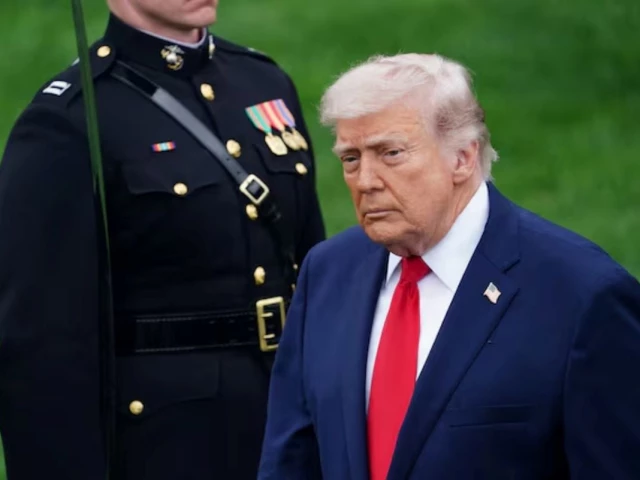
US President Donald Trump announced a new initiative, Project Freedom, on Sunday to escort stranded vessels out of the Strait of Hormuz starting Monday. The move aims to assist neutral countries whose ships have been caught in the conflict, according to Trump.
Trump expressed dissatisfaction with Iran’s proposals and warned that any interference with the operation would be met with force. Meanwhile, Iran’s Revolutionary Guards (IRGC) hardened their stance, telling the US president to choose between “impossible” strikes or a “bad deal”.
Several countries have approached Washington seeking help to free ships locked up in the strategic waterway, despite having nothing to do with the regional dispute. Trump said the United States would guide these ships safely out of restricted waters and resume normal commercial activity.
The initiative is meant to assist people, companies, and countries that have done nothing wrong, he added. If interference occurs, it will be dealt with forcefully due to concerns over food and essential supplies running low for crews.
Trump described the effort as a humanitarian gesture on behalf of the US and Middle Eastern countries, particularly Iran. He said his representatives were engaged in positive discussions with Tehran that could lead to something positive for all.
The development comes amid continued instability in and around the Strait of Hormuz, a key global shipping route where tensions have disrupted maritime traffic and raised concerns over supply chains and regional security.
Earlier, Tehran warned Washington it faced a choice between an “impossible” military operation or a “bad deal”. Iran’s Tasnim and Fars news agencies reported that Tehran had submitted a 14-point proposal through Pakistan. Trump cast doubt on its viability, reiterating that renewed strikes remain a possibility.
Despite the ceasefire entering its fourth week, rhetoric has intensified. The IRGC reiterated that Trump must choose between an “impossible operation” or a “bad deal”. Both sides have hardened their positions, leaving the path forward uncertain and exposing the limits of both military pressure and diplomacy.
Observers say backchannel diplomacy remains active, with the coming week seen as potentially significant. A possible diplomatic window is also being viewed ahead of Trump’s planned visit to Beijing later this month. Pakistan continues to play a key mediating role, according to Iran’s Ambassador to Pakistan.
Iranian state media reported that Tehran’s proposal calls for resolving all issues within 30 days rather than extending the ceasefire. It includes guarantees against renewed attacks, withdrawal of US forces, lifting of the naval blockade, restoration of frozen assets, compensation for damages, removal of sanctions, and an end to hostilities across all fronts.
In a late-night post, Iran’s Foreign Ministry spokesperson Esmaeil Baghaei said the US response had been received through Pakistan and was under review.
The Aga Khan University's (AKU) Centre for Innovation in Medical Education (CIME), Karachi, hosted SIMPACT…
Meezan Bank, Pakistan's premier Islamic bank, once again partnered with The Indus Hospital & Health…
Pakistan’s leading digital microfinance bank, Mobilink Bank, and Yango, part of the global technology company…
Pakistan’s freelancing market is rapidly emerging, and the export earnings of Pakistani freelancers are expected…
To celebrate the release of Atif Aslam’s highly anticipated new album, Subah Aye Na, Spotify…
KARACHI: Supernet Technologies Limited (STL) is looking to strengthen its working-capital capacity as a growing…
This website uses cookies.
