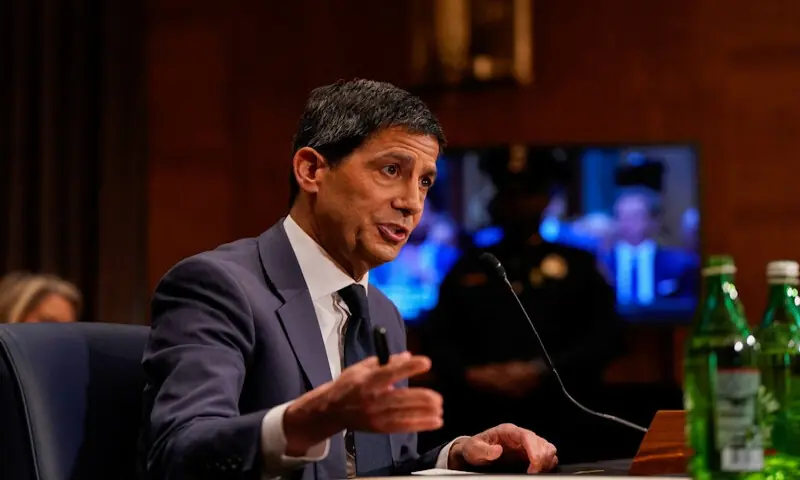
Donald Trump’s chosen Federal Reserve leader, Kevin Warsh, emphasized during his confirmation hearing on Tuesday that he would not be controlled by the president. Warsh, a former Fed governor, stressed his commitment to ensuring monetary policy remains strictly independent.
He denied accusations from critics that he is Trump’s puppet, stating, “The president never asked me to predetermine, commit, fix, decide on any interest rate decision in any of our discussions… nor would I ever agree to do so.”
Warsh also criticized the Fed for missing its inflation target since the Covid-19 pandemic, warning that once inflation takes hold, it becomes harder to control.
The hearing before the Senate Banking Committee is crucial as Warsh must overcome key hurdles to succeed Fed Chair Jerome Powell when his term ends on May 15. Trump has been vocal in criticizing the Fed for not cutting interest rates more aggressively, with the president telling CNBC he would be disappointed if the new chair did not lower rates swiftly.
Warsh insisted that it’s up to the Fed itself to stay free from political influence, stating, “I do not believe that independence of monetary policy is threatened when elected officials state their views on rates.”
All 11 Democrats on the Banking Committee urged a delay in Warsh’s nomination proceedings until separate investigations into Powell and Fed governor Lisa Cook are closed. Republican Senator Thom Tillis has also vowed to block all Fed nominees, including Warsh, until the Justice Department probe involving Powell is resolved.
Warsh needs confirmation from the panel to advance to a full Senate vote. Brookings senior fellow David Wessel told AFP that Warsh must demonstrate he intends to be a credible, independent central banker while avoiding angering Trump and appearing weak or subject to political pressure.
The focus of the hearing will be on how closely Warsh is aligned with the president on rate cuts. During his tenure as a Fed governor from 2006-2011, Warsh was considered more hawkish but appears to have shifted his stance, according to ING economist James Knightley. He pointed out indications that Warsh supports tech investments and AI, which could change the US economy’s growth without generating inflationary pressures.
However, higher gasoline prices due to war in the Middle East pose an immediate challenge to rate cuts. Warsh will need to acknowledge near-term price shocks while explaining they may not create a persistent inflationary threat.
The Aga Khan University's (AKU) Centre for Innovation in Medical Education (CIME), Karachi, hosted SIMPACT…
Meezan Bank, Pakistan's premier Islamic bank, once again partnered with The Indus Hospital & Health…
Pakistan’s leading digital microfinance bank, Mobilink Bank, and Yango, part of the global technology company…
Pakistan’s freelancing market is rapidly emerging, and the export earnings of Pakistani freelancers are expected…
To celebrate the release of Atif Aslam’s highly anticipated new album, Subah Aye Na, Spotify…
KARACHI: Supernet Technologies Limited (STL) is looking to strengthen its working-capital capacity as a growing…
This website uses cookies.
