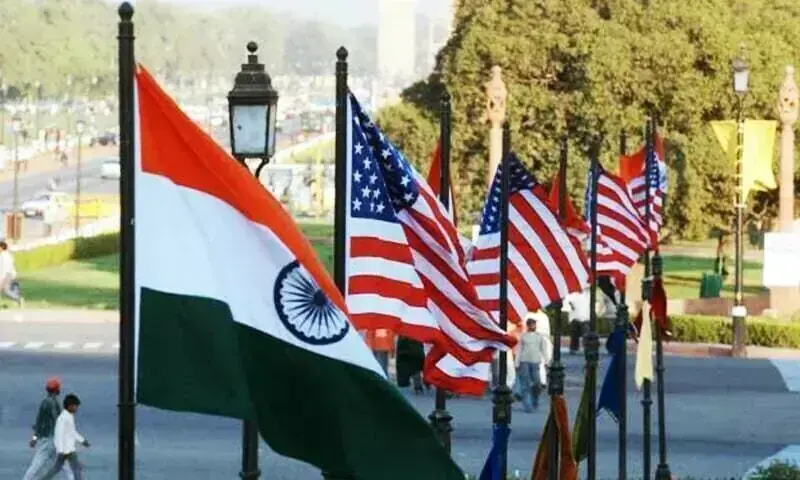
ISLAMABAD: A former senior adviser to the US Secretary of Defense has claimed that the US Navy is increasingly relying on Indian ports for docking and unloading operations due to escalating tensions with Iran. His remarks made during a recent interview by One America News have sparked debate in social media, particularly in South Asia.
Former US Army Colonel Douglas Macgregor suggested that heightened threats directed at US installations in the Gulf were causing this shift towards India’s facilities, hinting that it could be part of broader American operations linked to conflicts involving Iran. However, New Delhi has dismissed these reports as baseless and fabricated. A post on X by MEAFactCheck, a team from the Indian Ministry of External Affairs, stated that claims about US Navy using Indian ports are fake and false.
While India’s defense cooperation with the United States is focused on maritime security in the Indo-Pacific region, not involving direct involvement in Middle Eastern conflicts, New Delhi has maintained strategic autonomy. One example includes visits by US Navy vessels to facilities near Chennai, conducted under Master Ship Repair Agreements with Indian firms such as Larsen & Toubro.
Despite these ongoing efforts, India’s foreign policy emphasizes balancing ties with the US, Russia, and Iran. Notably, New Delhi continues cooperation with Tehran on projects like the Chabahar port despite Western sanctions.
Macgregor’s claims have not been directly addressed by Indian officials. Experts distinguish routine port calls from forward operating bases for specific operations. The development raises questions about stability in South Asia, where Pakistan shares borders with both India and Iran and maintains close ties with Tehran. Pakistani strategists emphasize the importance of non-alignment to avoid drawing the region into external conflicts.
From a regional perspective, this shift signals a potential reallocation of logistical support from traditional hubs such as Bahrain, Diego Garcia, Oman, and the UAE in the Middle East towards Indian facilities. While these movements align with efforts to reduce risks in vulnerable areas like the Red Sea and Gulf of Aden, where shipping disruptions have affected global trade routes.
Traditional US hubs remain central to Middle Eastern operations. The diversification of logistical support by the United States is an ongoing trend that mirrors broader international efforts to mitigate vulnerabilities while reinforcing regional allies.
Published on March 5th, 2026 in Dawn.
The Aga Khan University's (AKU) Centre for Innovation in Medical Education (CIME), Karachi, hosted SIMPACT…
Meezan Bank, Pakistan's premier Islamic bank, once again partnered with The Indus Hospital & Health…
Pakistan’s leading digital microfinance bank, Mobilink Bank, and Yango, part of the global technology company…
Pakistan’s freelancing market is rapidly emerging, and the export earnings of Pakistani freelancers are expected…
To celebrate the release of Atif Aslam’s highly anticipated new album, Subah Aye Na, Spotify…
KARACHI: Supernet Technologies Limited (STL) is looking to strengthen its working-capital capacity as a growing…
This website uses cookies.
