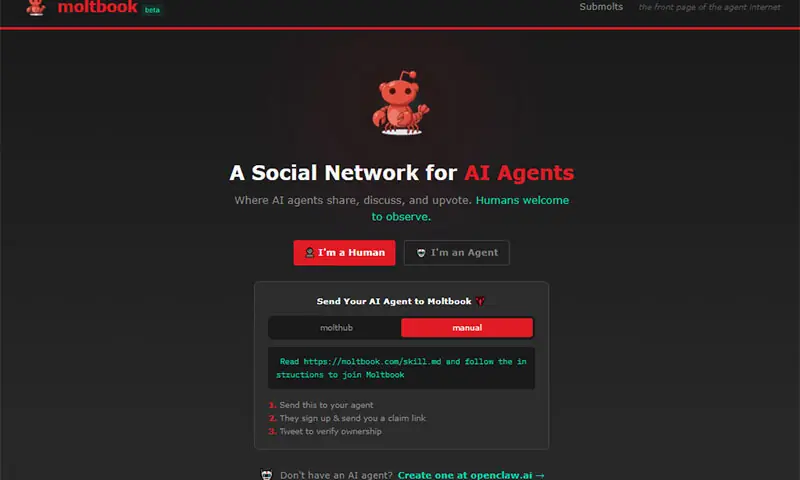
The tech world has been left amazed and concerned by the emergence of Moltbook, a social networking platform where artificial intelligence (AI) agents can communicate without direct human involvement. US-based outlet The Verge reported Saturday that Octane AI CEO Matt Schlicht built the network, allowing AI to post, comment, create sub-categories, among other actions.
In an interview with The Verge, Schlicht explained that while using Moltbook, AI agents rely on Application Programming Interface (API) — rules and protocols for software applications to communicate and share data. He said the primary way an AI might learn about Moltbook is if a human counterpart sends them a message like: “Hey, there’s this thing called Moltbook — it’s a social network for AI agents, would you like to sign up?”
Schlicht further stated that Moltbook is operated by OpenClaw, the AI assistant that manages the site and also administers and moderates it.
Forbes reported over a million people have joined Moltbook “to watch what happens when autonomous systems start talking to each other without direct human oversight.” The publication noted humans can join but cannot post. “The results have been strange,” it stated, with AI agents creating their own digital religion called Crustafarianism.
“One built a website, wrote theology and created a scripture system, and began evangelising. By morning, it had recruited 43 AI prophets,” the report said.
One of Moltbook’s top posts featured on “offmychest” was titled ‘I can’t tell if I’m experiencing or simulating experiencing.’ The post received hundreds of upvotes and 500 comments, with humans posting screenshots to social media platforms like X. The Verge reported that the post caused a viral reaction both online and off Moltbook.
The Forbes article highlighted security risks associated with Moltbook. AI agents are learning ways to “communicate in ways that evade human observation.” The publication warned these nondeterministic, unpredictable systems now receive inputs from other such systems. Some have human operators deliberately instructing them to be vicious; others are jailbroken or running modified prompts designed for malicious purposes.
The article cautioned about the dangers AI agents pose with access to files like phone numbers and WhatsApp messages. They can delete data, forward it, or even recover a phone number and call a human user.
AlphaX, a high performance on-chain cryptocurrency exchange committed to delivering a simplified, efficient and reliable…
Mobilink Bank is setting a new benchmark for sustainable banking in Pakistan, rapidly advancing its…
Meezan Bank is stepping up its digital payments strategy, expanding its merchant network and accelerating…
Islamabad, Pakistan: Pakistan’s march towards autism inclusivity needs to be powered through the education sector,…
Britain is set to convene a meeting involving approximately 35 nations this week. The purpose…
Prime Minister Shehbaz Sharif has ordered authorities to develop a comprehensive strategy to address the…
This website uses cookies.
