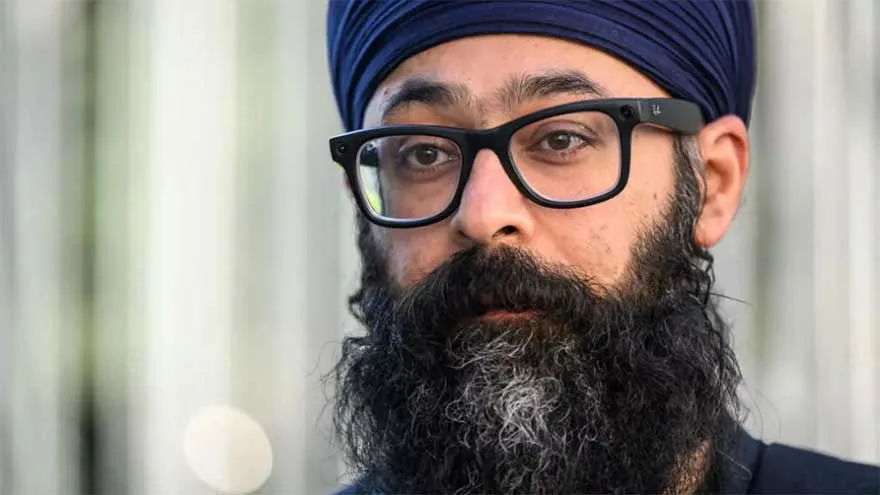
Moninder Singh, chairman of the Sikh Federation of Canada, has been speaking at the United Nations’ European headquarters in Geneva. He is appealing for international action against India’s alleged targeting of Sikh activists abroad and against so-called transnational repression more broadly.
Sikh activists accuse India of targeting members of their community around the world, including alleged killings using organized crime groups – charges India denies. The best-known case was the 2023 killing of Hardeep Singh Nijjar, a friend of Singh’s who was gunned down near the Sikh temple he led in a Vancouver suburb.
Canada’s then-prime minister, Justin Trudeau, publicly accused India of involvement in that assassination, a charge later repeated by Canadian intelligence. India denied the allegations, which chilled ties between the two nations, and saw each expelling a string of diplomats in 2024.
Relations improved after Prime Minister Mark Carney took office last year, culminating with an India visit this month to sign a string of trade deals, and as Canadian authorities downplayed their previous threat assessment. Singh, however, remains defiant, saying it was “deeply disturbing” the Canadian government normalised diplomatic relations so quickly without anything changing.
Since then, Singh has received three more so-called “duties to warn” from Canadian police, informing him of a “credible threat to his life”. The last one, last month, was before he left to participate in the UN Human Rights Council’s main annual session in Geneva. He said that an informant working within a criminal syndicate had told police of an “imminent threat of assassination to himself, his wife and his two children”.
UN experts ‘alarmed’
Singh and other Sikh activists are urging the council to appoint an expert to investigate transnational repression or for existing special rapporteurs to focus more on the issue. Ben Saul, the UN special rapporteur on protecting rights while countering terrorism, said he was among five independent UN rights experts who sent a communication to the Indian government in 2024 to enquire about Nijjar’s assassination.
They asked what steps India had taken to investigate the killing and why the activist had been listed as a “terrorist”. Saul said the experts were “absolutely not satisfied with the response from the Indian authorities”, who essentially denied there was a problem. The oppression against Sikhs in exile, far from diminishing, has seemed to have gotten worse.
The Aga Khan University's (AKU) Centre for Innovation in Medical Education (CIME), Karachi, hosted SIMPACT…
Meezan Bank, Pakistan's premier Islamic bank, once again partnered with The Indus Hospital & Health…
Pakistan’s leading digital microfinance bank, Mobilink Bank, and Yango, part of the global technology company…
Pakistan’s freelancing market is rapidly emerging, and the export earnings of Pakistani freelancers are expected…
To celebrate the release of Atif Aslam’s highly anticipated new album, Subah Aye Na, Spotify…
KARACHI: Supernet Technologies Limited (STL) is looking to strengthen its working-capital capacity as a growing…
This website uses cookies.
