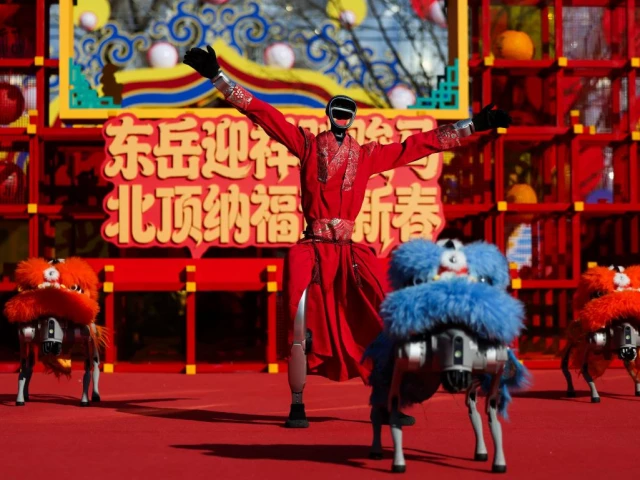
China’s annual CCTV Spring Festival Gala, broadcasted with the same fervor as the Super Bowl in the United States, this year highlighted cutting-edge industrial policy and a significant push towards humanoid robots. The gala featured four rising startups—Unitree Robotics, Galbot, Noetix, and MagicLab—demonstrating their latest innovations.
Four complex routines were showcased by Unitree’s G1 robots at the gala; these robots achieved unprecedented success, performing an autonomous Kung Fu sequence, a feat that set multiple world records. H2 bots added to this impressive display by exhibiting a striking performance alongside human children. In another segment, Unitree’s humanoid performers, along with over a dozen of their counterparts, mimicked “drunken boxing” martial arts, showcasing the robots’ advancements in multi-robot coordination and fault recovery.
The gala featured Bytedance’s AI chatbot Doubao interacting with its human counterpart, while Noetix and MagicLab bots danced alongside humans during a song performance. This year’s programming saw an increased focus on humanoid robotics, as major players such as AgiBot and Unitree prepare for initial public offerings (IPOs) this year.
Stylistic Innovations
The opening sketch showcased Bytedance’s AI chatbot Doubao interacting with a human participant during the gala. Meanwhile, Noetix and MagicLab robots danced alongside humans during another segment of the show.
Unitree Robotics CEO met President Xi Jinping at a high-profile tech symposium—a first in over three years since 2018. During this event, Xi Jinping interacted with five robotics startup founders, similar to his interactions with four electric vehicle and four semiconductor entrepreneurs over the same period.
Highlighting China’s Industrial Strength
The gala’s industrial policy pipeline is evident, as companies that appear on the stage receive tangible rewards in government orders, investor attention, and market access. As of last year, the Spring Festival Gala drew 79% of live television viewership in China and has long been used to showcase Beijing’s tech ambitions.
What distinguishes the gala from other similar events is the direct pipeline from industrial policy to prime-time spectacle. Behind these displays of humanoid robots performing marathons or kung-fu kicks, there lies a strategic push for AI manufacturing, particularly as China seeks solutions for an aging workforce.
Analysts attribute this prominence in robotics and AI strategy to China’s unique blend of strengths: advanced AI capabilities, robust hardware supply chains, and ambitious manufacturing ambitions. These advancements make humanoid robots “legible,” visible and understandable forms of public engagement.
Omdia data reveals that China accounted for 90% of the global shipment volume of approximately 13,000 humanoid robots last year—far surpassing US competitors like Tesla’s Optimus. Elon Musk has expressed his anticipation that Chinese companies could be his biggest competitors as they pivot towards embodied AI and their flagship humanoid Optimus.
Despite popular perception, China is a formidable competitor in the robotics sector, setting new benchmarks through its technological prowess and industrial aspirations. As the world watches, China continues to innovate at the forefront of manufacturing and artificial intelligence, demonstrating how technology can both challenge and strengthen global dynamics.
Iranian Drone Attack Hits Fuel Tanks at Kuwait International Airport An Iranian drone attack on…
Oracle, a leading tech firm, announced significant job cuts as part of its expansion into…
Armed men struck again in Haiti's Artibonite region on Tuesday, following a weekend attack that…
Jenny McCarthy believes it was definitely Jim Carrey who attended the César Awards. The actress,…
Chief Justice Yahya Afridi chaired the tenth interactive session at the Supreme Court on Tuesday…
Avatar: Fire and Ash, the third installment following its billion-dollar success, is now available on…
This website uses cookies.
