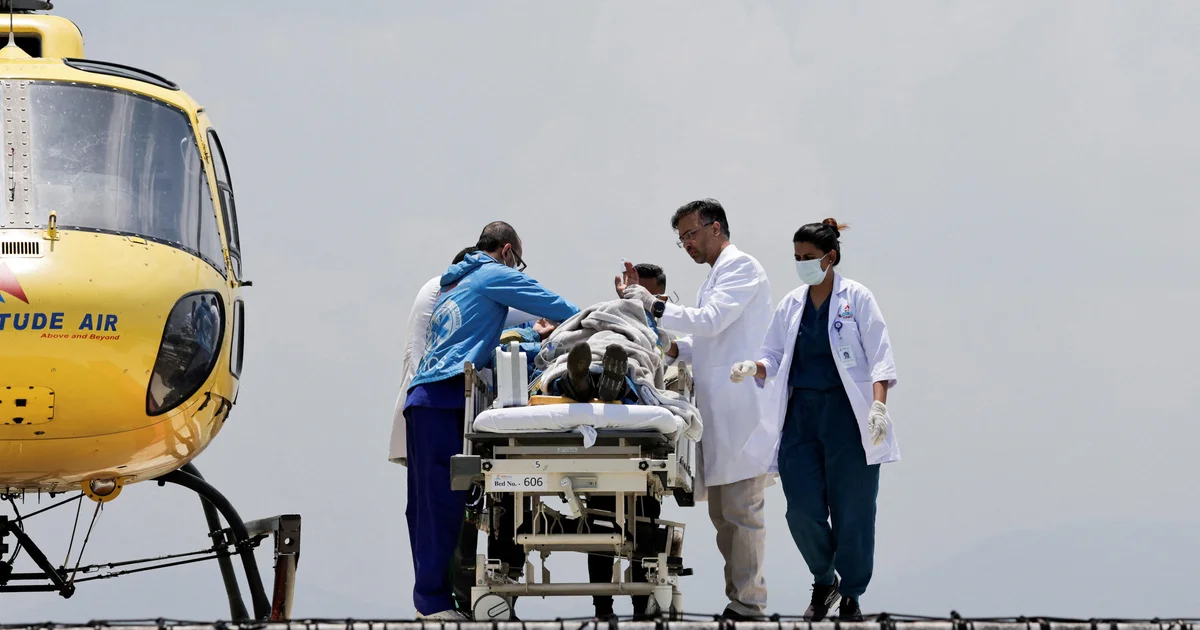
Nepali mountaineer Dawa Sherpa, 57, has been moved from intensive care as he slowly recovers after spending six days dragging himself off Mount Everest following abandonment, his family stated on Tuesday. The climber had previously said from his hospital bed that he believed he would die on the world’s highest peak.
His survival has sparked celebration among fellow climbers but also anger from family members and the mountaineering community over the failure to locate him sooner. Dawa Sherpa disappeared on May 30 during one of the final climbs of the spring season, found on Thursday morning crawling towards Base Camp, and airlifted to Kathmandu for treatment.
“He has been shifted from the ICU (intensive care unit) to the ward and treatment is ongoing — he is able to speak a little and is eating,” his relative, Nuru Sherpa, told AFP. “Doctors are observing his hands and legs for improvement.”
Stranded in freezing temperatures near Everest’s ‘death zone,’ Dawa Sherpa survived with almost no food or water, chewing ice hard as it hurt his teeth.
Left by the Sagarmatha Pollution Control Committee, a Nepali team that helps set routes on Everest and clean up waste left behind, he was found still slowly moving towards Base Camp. Maya Sherpa, president of the Everest Summiteers Association, has called for an investigation into negligence in his case.
The Nepal Mountaineering Association has also called for a government committee to investigate the incident. At least five climbers – two Indians and three Nepalis – died during this year’s Everest season. Over 1,000 climbers reached Everest’s summit, according to preliminary Nepali government figures, making it the busiest season on record.
The government collected more than $7 million from issuing climbing permits for Everest. On May 21, 274 climbers successfully ascended Nepal’s side of the mountain in a single day, setting a record. Experts have warned of potential dangers due to overcrowding, especially after two climbers died around that time. Increasing popularity not only increases congestion but also means less experienced climbers are more likely to attempt the trek, one sherpa told AFP. There is a need for authorities to control this number and let in only climbers of quality with a limit.”
The Aga Khan University's (AKU) Centre for Innovation in Medical Education (CIME), Karachi, hosted SIMPACT…
Meezan Bank, Pakistan's premier Islamic bank, once again partnered with The Indus Hospital & Health…
Pakistan’s leading digital microfinance bank, Mobilink Bank, and Yango, part of the global technology company…
Pakistan’s freelancing market is rapidly emerging, and the export earnings of Pakistani freelancers are expected…
To celebrate the release of Atif Aslam’s highly anticipated new album, Subah Aye Na, Spotify…
KARACHI: Supernet Technologies Limited (STL) is looking to strengthen its working-capital capacity as a growing…
This website uses cookies.
