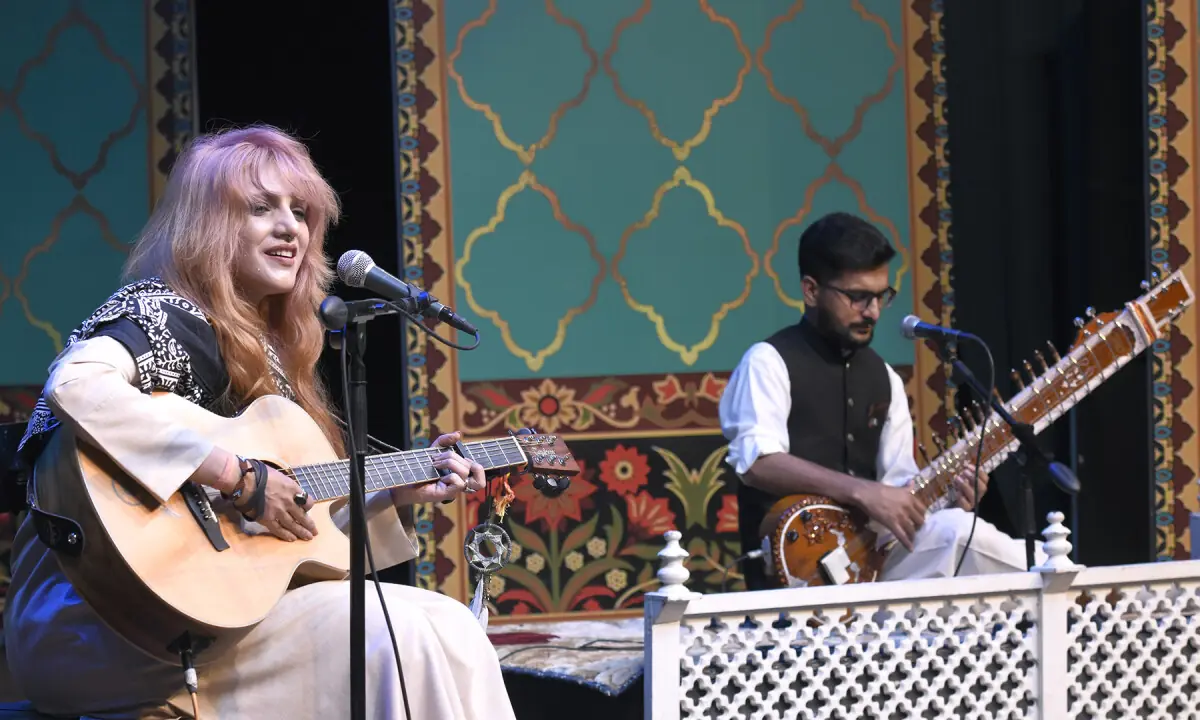
At this year’s Pakistan Mother Languages Literature Festival, celebrated as the Pakistan Mother Languages Literature Festival 2026, conversations shifted from celebration to sober reflection at the Pakistan National Council of the Arts (PNCA) on Saturday. The second day was marked by two major sessions — one honoring literary legends and another exploring endangered arts and musical instruments. Both sessions underscored a shared concern about cultural survival.
In the ‘Celebrating the Legends of Languages’ session, writers representing diverse mother tongues such as Brahui, Seraiki, Punjabi, Urdu, Balochi, Sindhi, and Potohari came together to pay tribute to their heritage. However, behind these tributes lay a pressing question: How do we ensure these languages are passed on?
Tahira Ehsaas Jattak, a celebrated Brahui language poet who was one of the first prominent female poets in her language, recounted her struggle for education and highlighted how times have changed; yet, many girls still ask about their language aspirations. “Today, I see more girls studying,” she said. “But I still ask: in which language are they dreaming? In English?”
Jattak emphasized that in parts of Balochistan, children are not being taught in their mother tongues despite recent initiatives to introduce local languages into curricula. This progress has stalled due to a lack of trained teachers and institutional support.
Balochi scholar Abdul Saboor Baloch spoke from his personal experience transitioning from reading magazines at school to teaching Balochi at the University of Balochistan, eventually leading international academic projects. He remained cautiously optimistic about the future, noting increased interest in learning the language among students but argued that preservation requires more than just passion—it needs policy backing.
The ‘Endangered Arts, Crafts and Instruments’ session featured a UNESCO documentary on the boreendo, an ancient clay wind instrument from Sindh. Film director Jawad Sharif shared how generational shifts have led to young musicians choosing instruments like the saxophone over traditional ones. He emphasized that archiving must go beyond documentation, recognizing the technical knowledge behind crafts, their history, and the context in which they exist.
Singer Salman Tahir of Citizens Archive Pakistan advocated for economic sustainability as a real battleground for cultural survival. “We can talk about preservation in air-conditioned halls,” he said, “but if an artist sleeps hungry, what kind of preservation is that?”
Balochi author Gulzar Gichki spoke passionately about the soroz, a bowed instrument integral to Balochi classical storytelling traditions. His book Suroz documents its history as both a musical tool and a vessel for epic poetry and even traditional healing. For him, this instrument isn’t just for music; it carries their stories.
Yet, like many indigenous instruments, the soroz faces dwindling practitioners. Youth activist Raaziq Faheem discussed efforts in Balochistan to train young people in folk instruments through structured programs. He argued that preservation must extend beyond museum displays, suggesting how these instruments can add value to contemporary life.
Across both sessions, speakers agreed on the need for innovation and adaptation alongside active custodianship—universities, archives, filmmakers, and cultural organizations were recognized as more than just observers. The festival felt less like a warning bell and more like a chorus: voices from every language asserting that heritage survives when communities choose to sustain it.
Speakers agreed on the importance of ensuring that change includes these languages. “Preservation is not about resisting change,” one speaker noted, “it is about ensuring that when change comes, it carries the language along with it.”
Header Image: Singer Rubaya Pirzada performs at the Pakistan Mother Languages Literature Festival at the Pakistan National Council of the Arts in Islamabad on February 14. — Tanveer Shahzad/White Star
The Aga Khan University's (AKU) Centre for Innovation in Medical Education (CIME), Karachi, hosted SIMPACT…
Meezan Bank, Pakistan's premier Islamic bank, once again partnered with The Indus Hospital & Health…
Pakistan’s leading digital microfinance bank, Mobilink Bank, and Yango, part of the global technology company…
Pakistan’s freelancing market is rapidly emerging, and the export earnings of Pakistani freelancers are expected…
To celebrate the release of Atif Aslam’s highly anticipated new album, Subah Aye Na, Spotify…
KARACHI: Supernet Technologies Limited (STL) is looking to strengthen its working-capital capacity as a growing…
This website uses cookies.
