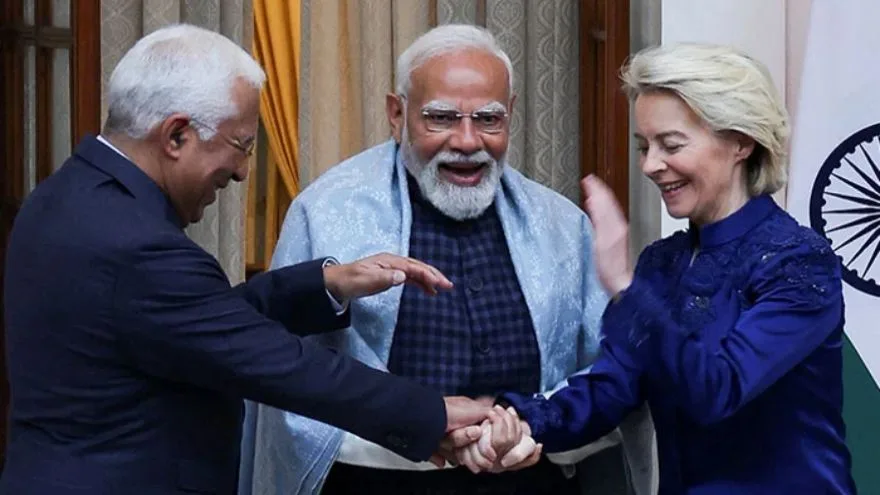
EU, India Announce “Mother of All Deals” in Trade Pact
EU leaders and Prime Minister Narendra Modi announced Tuesday a landmark trade pact that will cut or eliminate tariffs on almost 97% of European exports, saving up to €4 billion ($4.75 billion) annually in duties. The deal marks the most ambitious India has ever signed and comes as both Brussels and New Delhi seek new markets amid US tariffs and Chinese export controls.
India and the EU reached an agreement that will give European companies unprecedented access to Indian financial services, maritime transport, and other sectors like textiles, gems, and leather goods. Under the pact, tariffs on cars will be gradually reduced from a top rate of 110% to as low as 10%, while duties on processed foods — including pasta and chocolate — will be eliminated.
The trade pact also includes provisions for increased access to India’s financial services and maritime transport market, according to European officials. Additionally, India is expected to ease market access for key European products, such as steel and wines, aligning with EU standards.
“This deal brings many opportunities for both the 1.4 billion people of India and millions of Europeans,” Modi said at a joint press conference in New Delhi. “It represents about 25% of global GDP and one-third of global trade.”
The European Commission President Ursula von der Leyen highlighted the significance of this agreement, stating that it marks the creation of a free trade zone with two billion people, benefiting both sides significantly.
Both parties also launched a Security and Defence Partnership aimed at fostering collaboration on strategic issues such as defense industry and maritime security. EU officials expressed optimism about increased exports to India doubling within the next year.
The deal comes amid ongoing tensions between major global powers like China and the United States. With Russia’s reliance on key military hardware expected to decline, New Delhi has been seeking ways to diversify its imports while boosting domestic manufacturing capabilities.
India is set to become the fourth-largest economy by 2024, according to IMF projections. The trade pact underscores India’s commitment to a strategic partnership with Europe and represents a move toward greater openness in global economic relations.
The Aga Khan University's (AKU) Centre for Innovation in Medical Education (CIME), Karachi, hosted SIMPACT…
Meezan Bank, Pakistan's premier Islamic bank, once again partnered with The Indus Hospital & Health…
Pakistan’s leading digital microfinance bank, Mobilink Bank, and Yango, part of the global technology company…
Pakistan’s freelancing market is rapidly emerging, and the export earnings of Pakistani freelancers are expected…
To celebrate the release of Atif Aslam’s highly anticipated new album, Subah Aye Na, Spotify…
KARACHI: Supernet Technologies Limited (STL) is looking to strengthen its working-capital capacity as a growing…
This website uses cookies.
