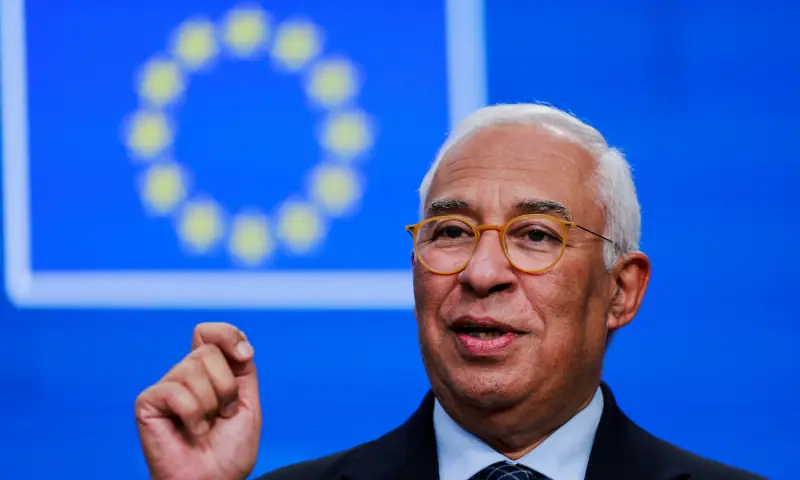
European Council President Antonio Costa arrived in India last Sunday for a series of engagements ahead of significant summits with New Delhi. The visit aims to conclude negotiations on a free trade agreement, which have spanned nearly two decades and involve key players from both the European Union (EU) and India.
Chief guests at this year’s Republic Day celebrations in New Delhi will include EU President Ursula von der Leyen alongside Costa for Monday’s festivities. This culminates with an EU-India summit on Tuesday, where there is hope of sealing a landmark agreement known as the “mother of all deals.”
This summit promises to further strengthen collaboration across critical policy areas within the existing EU-India strategic partnership. India’s economic importance has grown significantly, particularly its projected status as the fourth-largest economy globally this year, according to IMF projections.
For the EU, India is considered a vital market for future growth. Conversely, New Delhi perceives the European Union as an essential source of technology and investment necessary to bolster its infrastructure development and create millions of new jobs.
EU President Ursula von der Leyen emphasized the importance of such an agreement during pre-summit remarks, stating it represents “a major win” for both parties. Trade figures indicate a robust bilateral relationship: in goods alone, EU-India trade reached €120 billion ($139 billion) in 2024, marking nearly a 90% increase from the previous decade.
Services-related trade further contributes an additional €60 billion ($69 billion). Despite reaching this milestone figure, negotiations continue to address several contentious issues. These include concerns over the EU’s carbon border tax impacting steel exports and harmonizing safety and quality standards across pharmaceuticals and automotive sectors.
India has been increasingly reducing its dependence on Russian military hardware in recent years through diversification and bolstering its own domestic manufacturing sector. This parallel movement mirrors Europe’s strategy of shifting away from US influence as part of the broader push against a fragmented global order exacerbated by conflicts, coercion, and economic disarray.
The Aga Khan University's (AKU) Centre for Innovation in Medical Education (CIME), Karachi, hosted SIMPACT…
Meezan Bank, Pakistan's premier Islamic bank, once again partnered with The Indus Hospital & Health…
Pakistan’s leading digital microfinance bank, Mobilink Bank, and Yango, part of the global technology company…
Pakistan’s freelancing market is rapidly emerging, and the export earnings of Pakistani freelancers are expected…
To celebrate the release of Atif Aslam’s highly anticipated new album, Subah Aye Na, Spotify…
KARACHI: Supernet Technologies Limited (STL) is looking to strengthen its working-capital capacity as a growing…
This website uses cookies.
