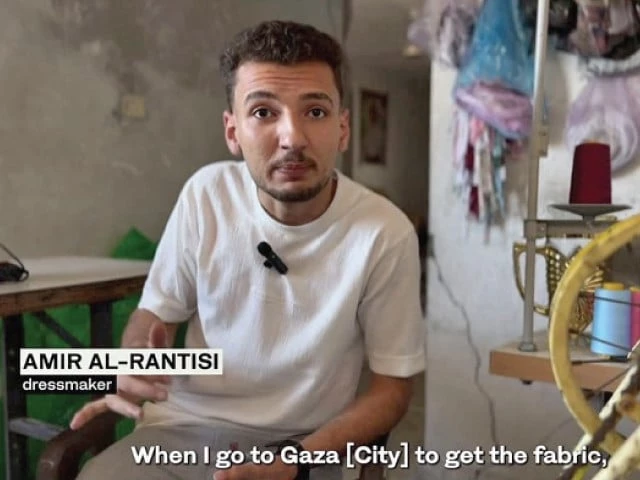
Amir al-Rantisi, a 24-year-old tailor from southern Gaza’s Khan Yunis area, has made it his mission to provide elegant dresses for young girls and women. Despite the devastation caused by the Israel-Hamas war, Amir salvages used fabrics and old dresses, recycling them into beautiful creations.
His colorful dresses hang outside his shop on makeshift mannequins, a stark contrast against the grey concrete and blackened buildings of Gaza. Inside, rows of ready-to-wear dresses line the walls, with customers carefully examining garments hanging from a clothesline across the storefront.
The workshop is always busy, but power outages often disrupt work. Amir has rigged an old bicycle pedal to his sewing machine to keep working during frequent power cuts. However, this makeshift solution makes sewing more difficult and inconvenient for Nisreen al-Rantisi, who works alongside her son in the shop.
The soaring cost of supplies is another challenge. With imports into Gaza severely restricted and shortages widespread, even basic materials have become expensive. A spool of black thread that once cost seven shekels ($2.40) now costs 50 shekels, according to Amir. Israel controls all entry points into the territory, limiting the number of trucks carrying aid and goods from entering Gaza, exacerbating war-inflated prices and shortages.
The Aga Khan University's (AKU) Centre for Innovation in Medical Education (CIME), Karachi, hosted SIMPACT…
Meezan Bank, Pakistan's premier Islamic bank, once again partnered with The Indus Hospital & Health…
Pakistan’s leading digital microfinance bank, Mobilink Bank, and Yango, part of the global technology company…
Pakistan’s freelancing market is rapidly emerging, and the export earnings of Pakistani freelancers are expected…
To celebrate the release of Atif Aslam’s highly anticipated new album, Subah Aye Na, Spotify…
KARACHI: Supernet Technologies Limited (STL) is looking to strengthen its working-capital capacity as a growing…
This website uses cookies.
