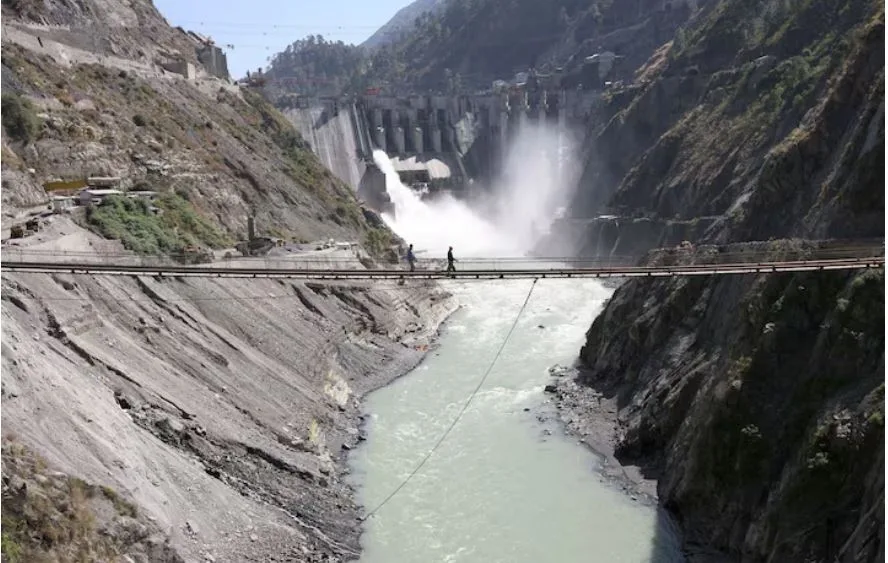
India has launched reservoir flushing operations at two major hydroelectric projects in Indian-administered Jammu and Kashmir following its decision to suspend the longstanding Indus Waters Treaty, sources familiar with the matter told Reuters. The move signals a sharp escalation in water diplomacy with Pakistan, a country heavily reliant on river flows governed by the agreement.
The operations began last Thursday at the Salal and Baglihar dams, both situated on the Chenab River. The effort, jointly undertaken by state-owned hydropower firm NHPC Ltd and local authorities, marks the first instance of such activity since the dams were commissioned in 1987 and 2008–09 respectively.
The Indus Waters Treaty, brokered by the World Bank in 1960, has withstood decades of geopolitical tensions—including three wars—between the two nuclear-armed nations. However, the pact was abruptly suspended by New Delhi last month following a deadly militant attack in Indian-administered Kashmir that left 26 dead. Pakistan has denied involvement and warned that any interference with water flows destined for its territory would be treated as an act of war.
The “flushing” operation, which lasted three days, involves draining the reservoir to remove sediment buildup that hampers electricity generation and turbine efficiency. “This is the first time such an exercise has taken place and will help in more efficient power generation and prevent damage to turbines,” a source told Reuters, adding that dam gates were opened from May 1 to enable the process.
Pakistan was not informed about the activity, as required under the treaty’s provisions, sources said. They noted that the flushing had been previously blocked under treaty conditions, which restrict India’s capacity to manipulate water flows on rivers allocated to Pakistan.
Residents along the Chenab River on the Indian side confirmed observing large volumes of released water between May 1 and 3. Although the impact on Pakistani water supplies is not immediate, experts say repeated or scaled-up operations across other projects in the region could eventually disrupt downstream irrigation and hydropower.
“Flushing is not a common practice because it leads to water loss,” one source noted, explaining that such actions typically require notification to downstream countries if flooding risks arise.
India’s Water Minister recently stated that his government aims to prevent any Indus water from reaching Pakistan. Officials have long argued that restrictions imposed by the treaty limit India’s ability to manage its own water infrastructure.
In recent years, New Delhi has pushed to renegotiate the treaty. Disputes over hydropower projects, including the Kishenganga and Ratle plants, have been referred to the Permanent Court of Arbitration in The Hague.
Kushvinder Vohra, a former chairman of India’s Central Water Commission, told Reuters that the suspension now allows India to advance its projects “at free will”.
While India’s current infrastructure does not allow it to completely divert flows, the shift in posture—combined with recent actions—has intensified regional concerns, with Pakistan weighing international legal recourse.
The Aga Khan University's (AKU) Centre for Innovation in Medical Education (CIME), Karachi, hosted SIMPACT…
Meezan Bank, Pakistan's premier Islamic bank, once again partnered with The Indus Hospital & Health…
Pakistan’s leading digital microfinance bank, Mobilink Bank, and Yango, part of the global technology company…
Pakistan’s freelancing market is rapidly emerging, and the export earnings of Pakistani freelancers are expected…
To celebrate the release of Atif Aslam’s highly anticipated new album, Subah Aye Na, Spotify…
KARACHI: Supernet Technologies Limited (STL) is looking to strengthen its working-capital capacity as a growing…
This website uses cookies.
