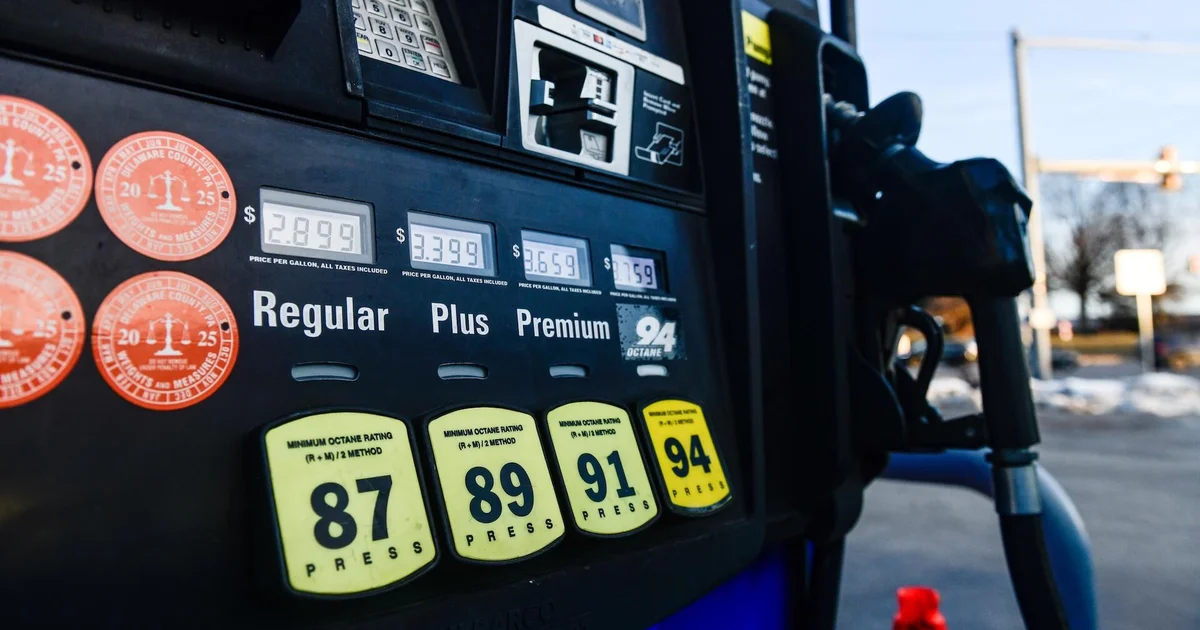
U.S. stock futures signaled steep losses as investors braced for potential disruptions to global energy supplies stemming from a looming war in the Middle East. Oil prices soared on fears that heightened tensions could impede crude transport, pushing benchmark U.S. and international Brent crude up by $3.24 and $3.56 respectively.
The S&P 500 futures pointed towards a decline of 1.5% at Tuesday’s open, while Dow Jones Industrial Average futures suggested a 1.6% drop, mirroring Monday’s trading session where initial concerns about the war’s impact on energy prices triggered a sell-off but ended with stocks rebounding modestly.
Airlines were among Wall Street’s biggest losers, particularly American Airlines, United, and Delta, which saw their shares slip by around 3% in premarket trading. The rise in oil prices significantly threatens these companies’ already substantial fuel expenses, compounded by the disruption caused by military action in the region, including closed airports and stranded travelers.
Analysts like Adam Crisafulli of Vital Knowledge highlighted this situation: “After initially taking the Middle East war in stride on Monday, anxiety among investors escalated overnight,” he remarked. “Now that a ‘decapitated and leaderless Iranian government and military’ could execute a prolonged retaliatory response targeting critical economic and energy infrastructure, it’s clear how significant and sustained concerns over oil prices can be.”
Market strategists from Morgan Stanley under Michael Wilson’s leadership believe a substantial and sustained decline in U.S. stocks due to the war would require crude oil prices surging above $100 per barrel. Stephen Innes of SPI Asset Management added, “Since 2000, there have been only 22 one-day spikes exceeding 10% for oil price. The market is well aware that past Middle East conflicts haven’t typically led to such significant stock downturns.”
The impact extended beyond U.S. shores as Asian airline stocks also faced sharp declines: ANA’s shares fell by 3.3%, Japan Airlines plummeted 6.4%, Korean Air declined 10.3%, and Qantas Airways dropped off at 1.8%.
In Germany, the DAX index sank by 2.9% to 23,935.62, while Britain’s FTSE 100 saw a 2.2% decline to close at 10,546.30. In France, the CAC 40 dropped by 2.2%, finishing below 8,207.
The Japanese benchmark Nikkei 225 suffered its worst day of the year, plunging 3.1% to finish at 56,279.05, reflecting Japan’s vulnerability given its dependence on oil and gas imports through the Strait of Hormuz. This disruption could significantly affect Japan’s economy.
The yen appreciated slightly from Monday’s close, with U.S. dollars rising to 157.53 Japanese yen versus 157.47 yen earlier in the day. On a global scale, currency markets saw volatility as well; the euro weakened further to $1.1627, down from $1.1692.
As investors remained wary of both geopolitical and economic risks, the outlook for equities across various sectors underscored how market resilience could be tested in this uncertain climate.
BYD, the world’s No. 1 NEV brand, in partnership with Mega Motor Company (MMC), is…
Karachi, Pakistan – September 18, 2026: Mashreq, one of the leading financial institutions in the…
The Aga Khan University's (AKU) Centre for Innovation in Medical Education (CIME), Karachi, hosted SIMPACT…
Meezan Bank, Pakistan's premier Islamic bank, once again partnered with The Indus Hospital & Health…
Pakistan’s leading digital microfinance bank, Mobilink Bank, and Yango, part of the global technology company…
Pakistan’s freelancing market is rapidly emerging, and the export earnings of Pakistani freelancers are expected…
This website uses cookies.
