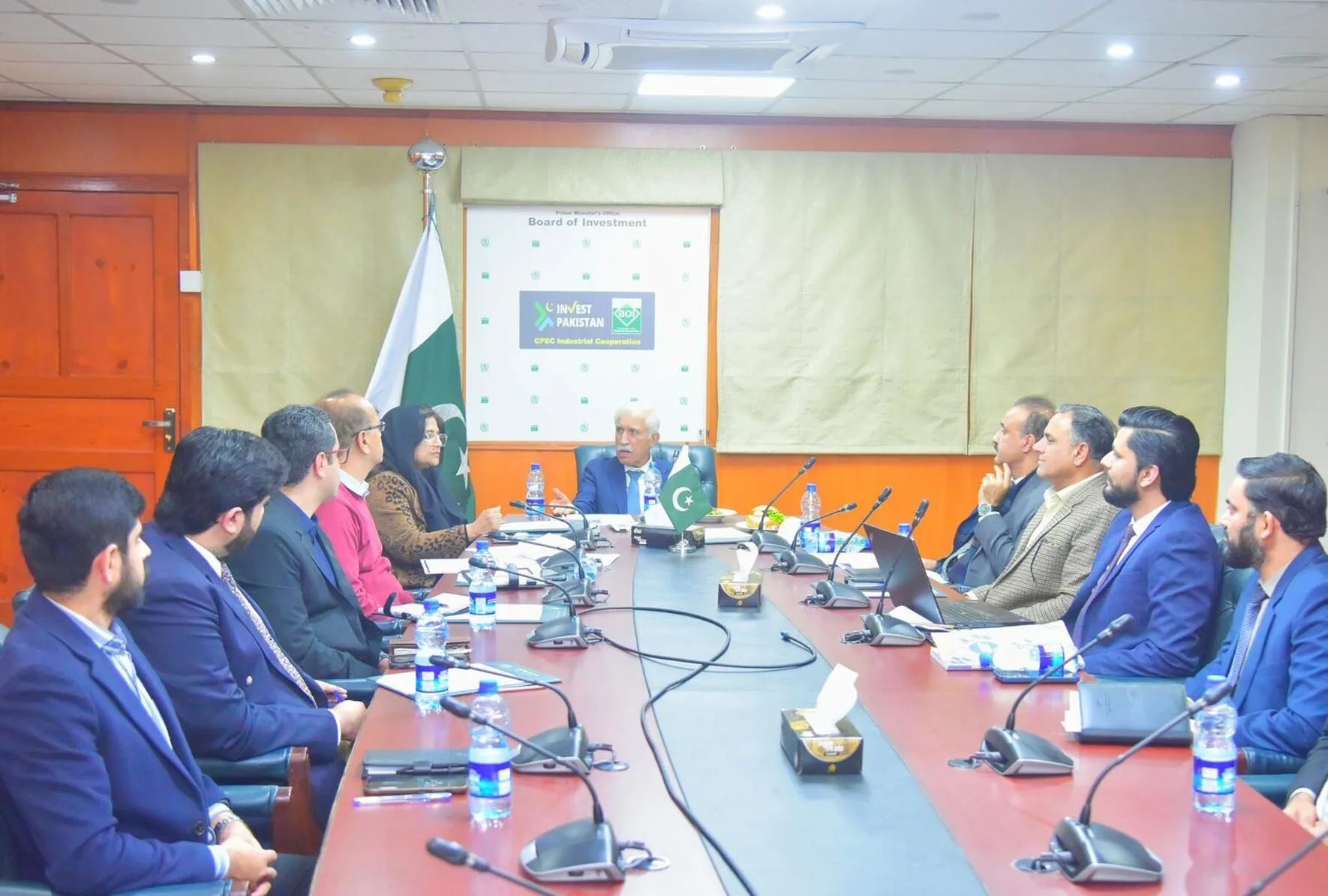
Federal Minister for the Board of Investment, Qaiser Ahmed Sheikh, on Friday reviewed progress on industrial cooperation and the development of Special Economic Zones (SEZs) under Phase-II of the China–Pakistan Economic Corridor during an official visit to the Project Management Unit of the CPEC Industrial Cooperation Development Project (PMU CPEC-ICDP) in Islamabad.
During the visit, the minister was briefed on Pakistan’s ongoing engagement with China under the upgraded CPEC framework, with a focus on SEZ-driven industrialisation and Pakistan-China business-to-business cooperation. Senior officials present included Additional Secretary BOI Dr Erfa Iqbal, Project Director PMU CPEC-ICDP Mehmood Tufail, Director General (SEZ) Riaz-ul-Haque, along with other BOI officers.
Officials outlined the coordinating role of PMU CPEC-ICDP as the implementation arm of BOI for industrial cooperation under CPEC. The Board of Investment serves as Pakistan’s lead agency for the Joint Working Group on Industrial Cooperation, working alongside China’s National Development and Reform Commission. Since 2019, the PMU has expanded Pakistan’s SEZ landscape, increasing approved zones from seven to 44 through the notification of 37 new SEZs.
The briefing highlighted progress on key initiatives, including the Karachi Industrial Park, development work at the Gilgit-Baltistan SEZ, and the approval of a Land Lease Policy for the BQIP, which has resolved a major hurdle for investors. The minister was also informed about steps taken to ensure the provision of utilities to SEZs, enabling several zones to move closer to operational status.
Officials further detailed BOI’s investment promotion strategy, particularly engagement with Chinese enterprises. Reference was made to the Pakistan-China B2B Investment Conference held during the official visit of Prime Minister Muhammad Shehbaz Sharif to China in September 2025, described as Pakistan’s largest international B2B engagement. The conference led to the signing of more than 160 memorandums of understanding and joint venture agreements, with a structured follow-up mechanism now in place.
The minister was also briefed on the finalisation of the Long-Term Plan for CPEC Industrial Cooperation, which is being implemented through an action plan aligned with the transition to CPEC 2.0. The plan prioritises industry-led growth, export-oriented manufacturing, technology transfer and value addition, with SEZs serving as anchor platforms.
It was noted that the industrial cooperation agenda under CPEC is aligned with the government’s “Uraan Pakistan” 5Es framework, particularly in boosting exports, improving competitiveness and supporting sustainable economic development. Officials added that 2026 will mark 75 years of diplomatic relations between Pakistan and China, with a series of commemorative and investment-focused initiatives planned during the year.
This post was last modified on January 16, 2026 5:27 pm
Meezan Bank, Pakistan's premier Islamic bank, once again partnered with The Indus Hospital & Health…
Pakistan’s leading digital microfinance bank, Mobilink Bank, and Yango, part of the global technology company…
Pakistan’s freelancing market is rapidly emerging, and the export earnings of Pakistani freelancers are expected…
To celebrate the release of Atif Aslam’s highly anticipated new album, Subah Aye Na, Spotify…
KARACHI: Supernet Technologies Limited (STL) is looking to strengthen its working-capital capacity as a growing…
Master Changan Motors Limited (MCML), Pakistan’s No.1 new entrant and leading Chinese automotive brand, is…
This website uses cookies.
