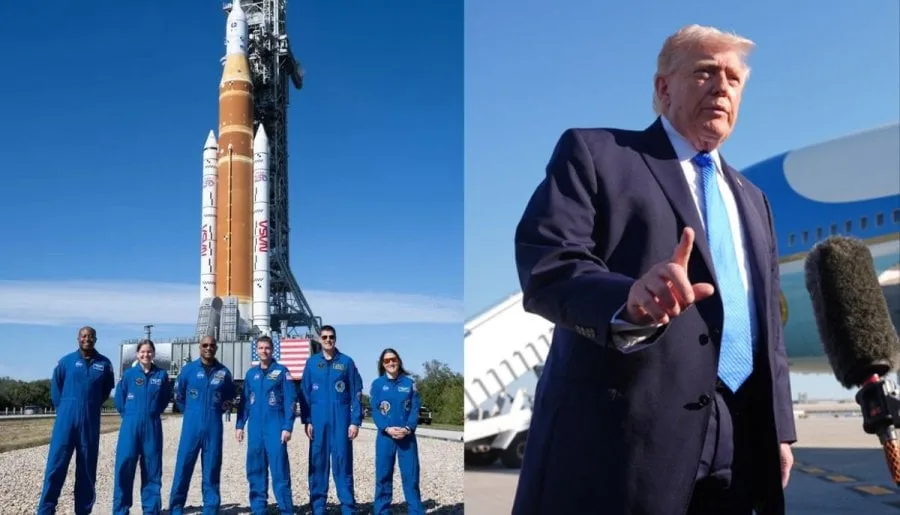
NASA’s Artemis II mission, set for April 1, 2026, marks humanity’s first Moon trip after over half a century. This isn’t just a flyby; it’s a continuation of an unexplored story from decades ago.
The mission stands at the brink of a new era, potentially reshaping space into a primary driver for Donald Trump’s “America First” agenda. A successful Artemis II could redefine the cosmos as a domain for US leadership and dominance.
Under Trump’s 2025 National Space Policy, Artemis II is not merely a scientific milestone but also accelerates the high-stakes race for “space superiority.”
China’s advancing lunar ambitions with its Chang’e 7 mission (launching mid-2026) to the south pole underscore this competition. NASA Administrator Jared Isaacman emphasizes that the US goal extends beyond flags and footprints, aiming instead for a permanent presence.
NASA unveiled a $20 billion plan to establish a lunar base, further emphasizing the Trump administration’s view of lunar superiority as a direct measure of American strength and prosperity.
The mission involves ambitions to explore valuable resources hidden on the Moon. Former NASA Administrator Sean O’Keefe views the Moon not just as a “dust bowl” or “barren land,” but as an economic gold rush, containing Helium-3 for nuclear fusion reactors, water ice for rocket fuel, and rare earth minerals like lithium and platinum.
The potential success of lunar mining could reduce US dependence on China’s dominance in rare earth mineral markets and advance the America First agenda. For NASA, Artemis II is not just a lunar mission but also paves the way towards future Mars missions.
Trump has hailed this as a means for “American astronauts to plant the Stars and Stripes on the planet Mars.” Libby Jackson, head of space at the Science Museum, sees the lunar base as a critical preparation phase for sending humans to Mars, refining life-support systems in a controlled environment.
This mission comes amid US political and social divisions but could become another historical precedent like Apollo 11. In 1969, despite the Vietnam War and civil rights unrest, an estimated 125 to 150 million Americans watched the Moon landing. Astrophysicist David Gerdes hopes this return will unite the country, bringing together a more diverse group of astronauts than those in the 1960s.
A month ago, Nariman al-Issa was like any other 12-year-old living in Beirut's southern suburbs.…
Sindh Information Minister Sharjeel Inam Memon announced that all educational institutions across the province will…
Lahore Sessions Court fined singer Meesha Shafi five million rupees on Tuesday in a defamation…
Indian police have arrested a man for smuggling alcohol into Delhi using camels, seizing two…
The (CCP) held a significant awareness session at the Lahore Chamber of Commerce & Industry…
Myanmar's Military Appoints 60-Year-Old General as Commander-in-Chief On Monday, Myanmar's military appointed a 60-year-old general…
This website uses cookies.
