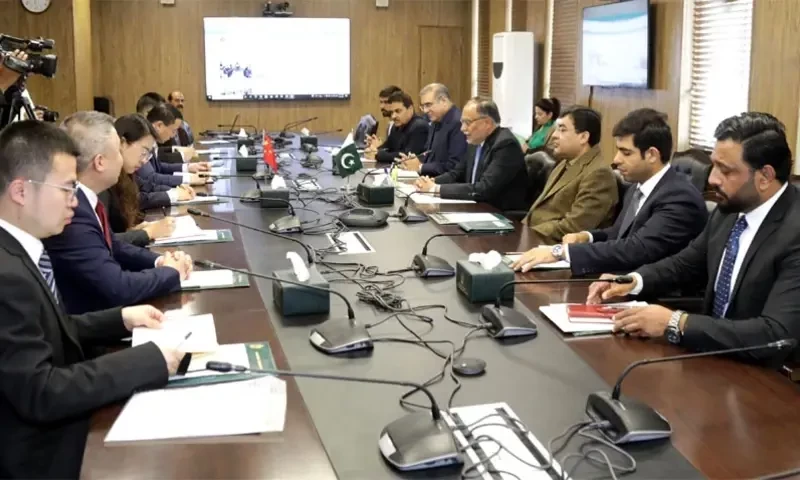
Pakistan and China have agreed to establish a Working Group (WG) on five new economic corridors under the second phase of the China-Pakistan Economic Corridor (CPEC), aligning with Pakistan’s 5Es framework.
The agreement was reached during a meeting between Federal Minister of Planning, Development, and Special Initiatives, Professor Ahsan Iqbal, and Chinese Ambassador to Pakistan, Jiang Zaidong.
The five new economic corridors, including the Corridor of Job Creation, Corridor of Innovation, Corridor of Green Energy, and Inclusive Regional Development, aim to expedite CPEC phase 2. Both countries will prepare separate concept papers on these corridors, consolidating them for presentation at the upcoming Joint Coordination Committee (JCC) meeting in 2024.
Minister Iqbal outlined a strategic approach to maximize the success of special economic zones (SEZs) within Pakistan, proposing a “one plus Four” model. Under this model, each SEZ in Pakistan will partner with one province from China, one industry group, one SEZ from China to provide technical expertise, and a state-owned enterprise to spearhead SEZ development.
The Chinese envoy praised Pakistan’s efforts in implementing CPEC, suggesting that officers in charge of SEZs visit Chinese industrial parks to observe efficiency measures firsthand. The collaboration aims to expedite SEZ establishment and growth in Pakistan, enhancing competitiveness and investor attractiveness.
The Aga Khan University's (AKU) Centre for Innovation in Medical Education (CIME), Karachi, hosted SIMPACT…
Meezan Bank, Pakistan's premier Islamic bank, once again partnered with The Indus Hospital & Health…
Pakistan’s leading digital microfinance bank, Mobilink Bank, and Yango, part of the global technology company…
Pakistan’s freelancing market is rapidly emerging, and the export earnings of Pakistani freelancers are expected…
To celebrate the release of Atif Aslam’s highly anticipated new album, Subah Aye Na, Spotify…
KARACHI: Supernet Technologies Limited (STL) is looking to strengthen its working-capital capacity as a growing…
This website uses cookies.
