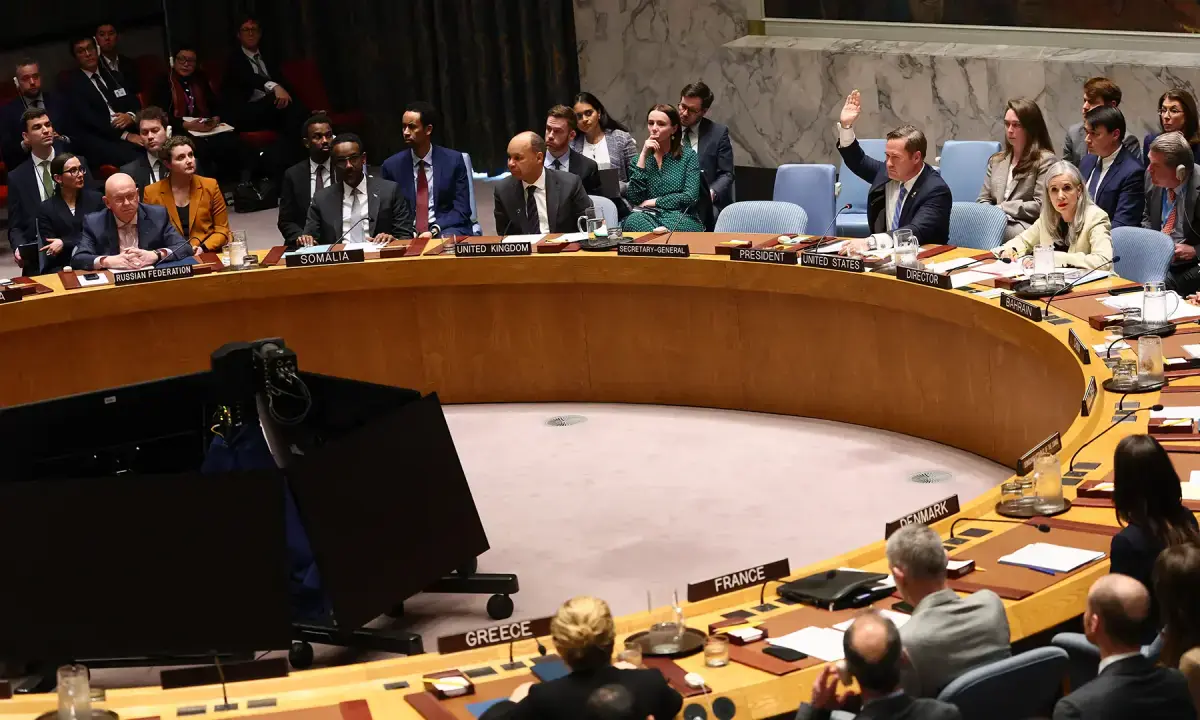
At a United Nations Security Council meeting on March 11, Pakistan outlined its rationale behind voting in favor of two competing draft resolutions. The council had just adopted a Bahrain-led resolution condemning missile and drone attacks by Iran against Gulf states — including Bahrain, Kuwait, Oman, Qatar, Saudi Arabia, the UAE, and Jordan — demanding an immediate cessation of such attacks. Russia presented another draft resolution addressing military escalation in the Middle East but was vetoed by the United States.
Pakistan supported both resolutions due to their shared goal of curbing regional escalations and promoting dialogue. Ambassador Asim Iftikhar Ahmad, Pakistan’s Permanent Representative to the UN, explained that while the Bahrain-led resolution focused on ending hostilities, Russia’s draft emphasized a return to negotiations. Both addressed urgent crises in the region.
“Everyone is impacted by the conflict we are witnessing,” said Ambassador Ahmad, warning of international law violations threatening peace and urging all parties to cease hostilities immediately. He described the Gulf states as having previously supported dialogue but noted they “should not have had to face such severe consequences.”
The ambassador highlighted Pakistan’s solidarity with its neighbors, particularly those targeted by Iran’s recent attacks. Pakistan condemned these unwarranted strikes, especially their impact on civilian lives and infrastructure in Gulf countries.
Ambassador Ahmad also addressed the human and economic impacts of regional conflict. At least two Pakistani nationals were killed during attacks on UAE territories, while millions living abroad remained vulnerable. Pakistan faced disruptions to its own energy supplies, with flights to and from the region experiencing cancellations or delays.
In addition to supporting an immediate cessation of hostilities, Pakistan voted in favor of Russia’s draft resolution urging all parties to halt further escalations and return to negotiations. Ambassador Ahmad expressed solidarity with Iran’s sovereignty, calling for a de-escalation process that respects international humanitarian law and upholds the principles enshrined in the UN Charter.
Pakistan has remained engaged in regional mediation efforts and maintains close contact with its partners to facilitate constructive discussions toward resolving this crisis. The ambassador concluded by reaffirming Pakistan’s call for all sides to exercise restraint, engage in diplomacy, and seek a negotiated solution to ensure lasting peace in the region.
The Aga Khan University's (AKU) Centre for Innovation in Medical Education (CIME), Karachi, hosted SIMPACT…
Meezan Bank, Pakistan's premier Islamic bank, once again partnered with The Indus Hospital & Health…
Pakistan’s leading digital microfinance bank, Mobilink Bank, and Yango, part of the global technology company…
Pakistan’s freelancing market is rapidly emerging, and the export earnings of Pakistani freelancers are expected…
To celebrate the release of Atif Aslam’s highly anticipated new album, Subah Aye Na, Spotify…
KARACHI: Supernet Technologies Limited (STL) is looking to strengthen its working-capital capacity as a growing…
This website uses cookies.
