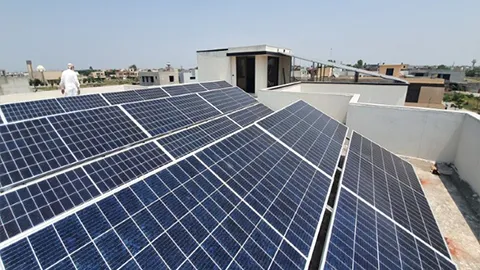
Pakistan has informed the International Monetary Fund (IMF) of its decision to replace the net metering policy for rooftop solar panels with gross metering, a move anticipated to impact electricity costs for consumers. This transition, revealed during ongoing negotiations with the IMF, coincides with Pakistan’s intention to seek $15.4 billion in energy debt restructuring from China.
Under the current net metering system, consumers have been able to offset expensive grid electricity costs by generating their own power through rooftop solar panels. However, the proposed shift to gross metering aims to discourage solar panel usage, citing concerns over the financial viability of power distribution companies amidst increasing competition from alternative energy sources.
Under the gross metering policy, electricity generated by rooftop solar panels would be fed into the national grid. Owners of solar panels would then consume units from the grid, resulting in reduced monetary benefits for residential consumers. This new system would involve separate meters to measure in-house generation and consumption, as opposed to the current bidirectional meter that calculates both rooftop generation and grid electricity import during nighttime.
The average base tariff in Pakistan, including idle capacity charges, stands at Rs29.79 per unit, with additional surcharges, fuel price adjustments, and taxes pushing residential consumer bills up to Rs62 per unit. The impending significant increase in electricity prices, scheduled for July, has also been highlighted, prompting concerns over its impact on consumers.
Furthermore, the Ministry of Energy’s focus on the financial implications of net metering, rather than idle capacity payments, has drawn scrutiny. The IMF has raised questions about Pakistan’s strategy to reduce electricity generation costs, with the government indicating debt restructuring with Chinese Independent Power Producers (IPPs) as a potential solution.
However, challenges remain as renegotiating capacity payments with Chinese IPPs under the China-Pakistan Economic Corridor (CPEC) proves difficult. The Ministry’s analysis suggests a modest reduction in tariffs through debt restructuring, falling short of the anticipated electricity cost reduction.
The IMF has also flagged idle capacity payments as a significant contributor to constant price hikes and called for a review of the captive power generation policy. This policy, granting industrialists access to cheaper gas for in-house electricity production, may undergo changes, potentially leading to a shift towards expensive grid electricity for industries.
This post was last modified on May 19, 2024 6:40 pm
The Aga Khan University's (AKU) Centre for Innovation in Medical Education (CIME), Karachi, hosted SIMPACT…
Meezan Bank, Pakistan's premier Islamic bank, once again partnered with The Indus Hospital & Health…
Pakistan’s leading digital microfinance bank, Mobilink Bank, and Yango, part of the global technology company…
Pakistan’s freelancing market is rapidly emerging, and the export earnings of Pakistani freelancers are expected…
To celebrate the release of Atif Aslam’s highly anticipated new album, Subah Aye Na, Spotify…
KARACHI: Supernet Technologies Limited (STL) is looking to strengthen its working-capital capacity as a growing…
This website uses cookies.
