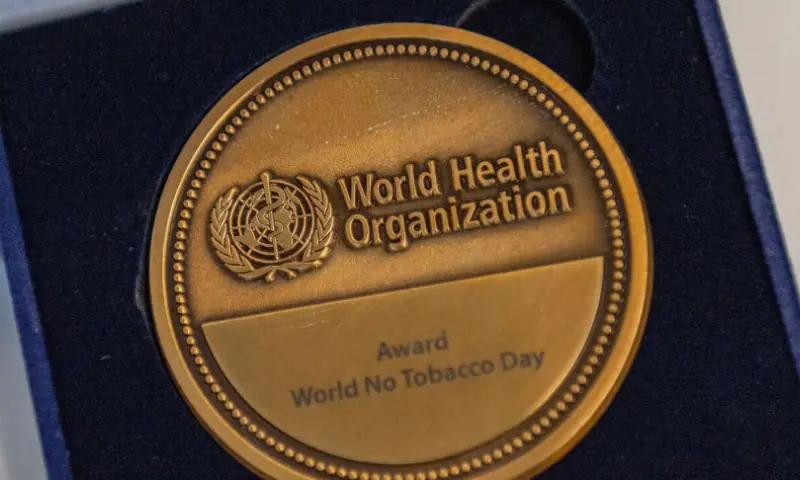
The World Health Organisation (WHO) has awarded the World No Tobacco Day (WNTD) 2026 Award to the Tobacco Control Cell of Pakistan’s Ministry of National Health Services, Regulations and Coordination. This recognition is in appreciation for their significant contributions to tobacco control and public health.
Dr Waseem Iftikhar Janjua, Senior Researcher at the Sustainable Development Policy Institute (SDPI), Pakistan, has also been honoured with the World Health Organisation’s WNTD 2026 Award. His outstanding efforts in advancing tobacco control and public health initiatives have not gone unnoticed.
The WNTD Award is presented annually to individuals or organisations from each of the six WHO Regions for their outstanding contributions to tobacco control. In Pakistan, tobacco causes an estimated 164,000 deaths and economic losses of over PKR 1,800 billion (around US$6.6 billion) each year.
WHO warns that children and youth are particularly exposed to and targeted by the tobacco and nicotine industries, which design their products to get young people stuck in a cycle of addiction. Pakistan ratified the World Health Organisation Framework Convention on Tobacco Control (WHO FCTC) in 2004, with continuous technical support from WHO for areas such as tobacco tax policy and track-and-trace implementation.
Since 2014, under the umbrella of WHO’s FCTC, Pakistan has implemented key policy changes to reduce tobacco consumption. These include a 208% increase in tobacco taxation during the fiscal year 2022–2023 (which remained unchanged in subsequent years), larger pictorial health warnings on tobacco packaging, a ban on the sale of loose cigarettes nationwide, and the establishment of provincial Tobacco Control Cells and Implementation and Monitoring Committees.
Extensive scientific evidence confirms that all tobacco and nicotine products on the market are extremely harmful to health. They pose a major risk to vulnerable populations such as children and teenagers, causing up to half of its users who don’t quit to succumb to cardiovascular and lung disease, strokes, and multiple cancers.
The Aga Khan University's (AKU) Centre for Innovation in Medical Education (CIME), Karachi, hosted SIMPACT…
Meezan Bank, Pakistan's premier Islamic bank, once again partnered with The Indus Hospital & Health…
Pakistan’s leading digital microfinance bank, Mobilink Bank, and Yango, part of the global technology company…
Pakistan’s freelancing market is rapidly emerging, and the export earnings of Pakistani freelancers are expected…
To celebrate the release of Atif Aslam’s highly anticipated new album, Subah Aye Na, Spotify…
KARACHI: Supernet Technologies Limited (STL) is looking to strengthen its working-capital capacity as a growing…
This website uses cookies.
