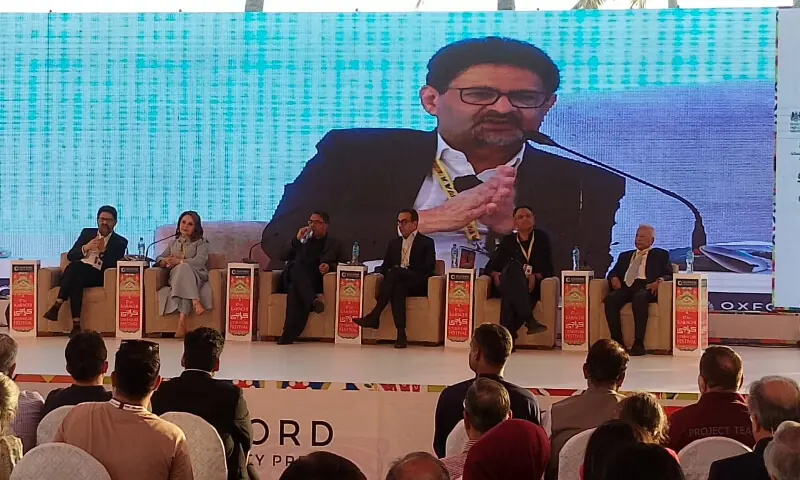
Leading economists and policymakers convened at the 17th Karachi Literature Festival (KLF), held during Pakistan’s annual celebration of literary discourse. At the Beach Luxury Hotel, these prominent figures addressed one of the country’s most pressing issues: the need for fundamental economic reforms. The event, titled “Fixing the Fundamentals: Pakistan’s Economic Reset,” brought together a diverse group including Dr Ishrat Husain, Muhammad Ali, and former finance ministers Asad Umar and Miftah Ismail.
Muhammad Ali highlighted that short-term measures would not suffice in addressing Pakistan’s economic challenges. He advocated for structural reforms, emphasizing improved documentation to tackle taxation issues, reducing the government’s role, boosting exports, increasing women’s participation in the workforce, decentralizing provincial governance, and empowering local governments.
Asad Umar stressed that a fundamental overhaul was necessary, urging Pakistan to produce goods that global markets demand. For him, shrinking state size is crucial for economic progress alone, not just through privatisation. He also linked sustainable growth with fair competition and an effective democratic system.
Miftah Ismail underlined the importance of stability in Pakistan’s economy, cautioning against any lingering threat from terrorism. Dr Ishrat Husain warned that the country has become overly reliant on raw materials and imports, calling for investment in sectors like steel, petrochemicals, pharmaceuticals, and lithium batteries to shift towards a more service-oriented growth model.
Zeelaf Munir pointed out that forums such as KLF offer spaces for honest discourse. She highlighted trust, transparency, and accountability as essential elements to address economic fundamentals effectively.
Muhammad Azfar Ahsan opened the session by calling for Pakistan to confront its economic realities honestly while adopting a long-term policy framework. He warned against hasty decisions without deep deliberation on these matters.
Participants at this event agreed that consensus-driven reforms were crucial, alongside export-led growth and better governance of state-owned enterprises. The panel drew in a sizable and engaged audience.
This year’s KLF, now in its 17th edition, serves as a vital platform for dialogue on literature, culture, public policy, and national development. It collaborates with Oxford University Press and is supported by the Government of Sindh.
The Aga Khan University's (AKU) Centre for Innovation in Medical Education (CIME), Karachi, hosted SIMPACT…
Meezan Bank, Pakistan's premier Islamic bank, once again partnered with The Indus Hospital & Health…
Pakistan’s leading digital microfinance bank, Mobilink Bank, and Yango, part of the global technology company…
Pakistan’s freelancing market is rapidly emerging, and the export earnings of Pakistani freelancers are expected…
To celebrate the release of Atif Aslam’s highly anticipated new album, Subah Aye Na, Spotify…
KARACHI: Supernet Technologies Limited (STL) is looking to strengthen its working-capital capacity as a growing…
This website uses cookies.
